« July 2005 | Main | September 2005 »
August 31, 2005
New Orleans: "A Logistical Nightmare"
Flood waters continue to rise in New Orleans in the aftermath of Hurricane Katrina as officials scramble to evacuate the remaining survivors:
NEW ORLEANS — There was simply no time to count the dead as engineers scrambled to plug two broken New Orleans levees and rescuers searched for survivors clinging to rooftops as the Gulf Coast continued to grapple with the aftermath of Hurricane Katrina.The flooding in New Orleans grew worse by the minute Wednesday, prompting Gov. Kathleen Blanco to say that everyone still in the city, now huddled in the Superdome and other rescue centers, needs to leave. She said she wanted the Superdome evacuated within two days as the broken levees continued to allow water to gush into the Big Easy, but it was still unclear where the people would go.
The New Orleans Times-Picayune News Blog which has been on top of the story from the beginning reports that buses and other vehicles are being sent into the area to aid with the evacuation. Four Navy vessels are being sent to the area to carry emergency supplies and the Army Corp of Engineers is scrambling to try to plug the two breached levees.
Governor Blanco held a press conference this morning with area religious leaders to encourage people to pray for the besieged city.
Relief efforts are being mobilized by a number of charities. Glenn Reynolds has a list of charities heading up the relief efforts with links for donations.
Bloggers are asked to join the Blog Relief Day for Katrina Relief tomorrow. Truth Laid Bear has a topic page of Katrina blog stories. You can also click here to register your blog for Blog Relief Day.
We'll continue to blog developments here and will have more soon on our participation in Blog Relief Day.
Our prayers are with the hurricane victims, their families, and everyone who has been touched by the overwhelming devastation of this storm.
Posted by Tom at 11:07 AM | Comments (0) | TrackBack
August 30, 2005
Katrina Update
My area of Alabama made it through Katrina with lots of power outages and debris but nothing too severe. I wish I could say the same for Mobile and the coastal regions of Mississippi and Louisiana. What a disaster. Whatever you can contribute, do so. Start here.
I'll say more later, after I've managed to process the images of the city of my birth, New Orleans, completely submerged in watery filth.
Posted by Matt at 03:54 PM | Comments (1) | TrackBack
Waters Continue to Rise in New Orleans
The waters are rising in New Orleans and the Mayor estimates that 80% of the city is under water.
Continued flooding of New Orleans is FEMA's worse-case scenario natural disaster scenario. The waters will not recede, as many news stations keep saying. The water levels may reach equilibrium, but there is literally no place for the water to go. It must be pumped out, an effort that will take weeks, if not months. Mobile AL and other cities along the gulf coast are also devastated. How many hundreds of thousands will be homeless? For how long?
Keep praying for the affected communities, emergency response personnel, and the long-term reconstruction efforts. Hugh Hewitt is looking for someone to organize a coordinated blogothon for relief efforts.
Josh Britton has all the relevant links.
Posted by Rick at 11:08 AM | Comments (0) | TrackBack
Perspectives on the War on Terror
Two columns today are well worth reading as they both provide perspectives on the War on Terror that need to be heard. First, Lorie Byrd contends that it's time to set the record straight about the war and deals directly with some of the common criticisms about the war:
What is rarely, if ever, addressed by the opponents of President Bush and the current war is whether or not the decision he made was a correct one if everything we thought about the status of Saddam’s WMD capability had been correct. Dick Cheney made the argument for the decision in at least one speech around the time of the release of the Kay report. In that speech he argued that knowing what we knew then, and looking at it in the shadow of the 9/11 attacks, it would have been irresponsible NOT to have invaded Iraq. Republicans who fail to make that case, and instead weaken their stance on the war in reaction to declining public opinion polls, risk losing the advantage they have long held over Democrats on issues of national security and defense. Even many of those voters who have not supported the Iraq war and view President Bush as a trigger happy cowboy are likely to prefer a candidate that supports the war – even if there are some reservations about the way the war was executed – to one who originally supported it only to back down when the going got tough.
Even more striking is Dennis Prager's column today in which he asks opponents of the war to answer one simple question:
All those who support the American war in Iraq should make a deal with anyone opposed to the war. Offer to answer any 20 questions the opponents wish to ask if they will answer just one: Do you believe we are fighting evil people in Iraq?That is how supporters of the war regard the Baathists and the Islamic suicide terrorists, the people we are fighting in Iraq.
Because if you cannot answer it, or avoid answering it, or answer "no," we know enough about your moral compass to know that further dialogue is unnecessary. In fact, dialogue is impossible. Our understanding of good and evil is so different from yours, there is simply nothing to discuss. Someone who was asked a hundred years ago "Do you believe that whites who lynch blacks are evil?" and refused to answer in the affirmative was not someone one could dialogue with.
This war is not about a particular religion. It's not a war against a nation or group of nations. It is a war against evil. We cannot afford to back down or withdraw. We must fight this war until the end.
Posted by Tom at 10:43 AM | Comments (5) | TrackBack
God, When They Need Him
The Air Force issued new directives yesterday that limit the expression of faith by its officers, while seeking to maintain the spiritual life of its academy and forces. However, the guidelines are rife with contradictions, and are unlikely to be unworkable in the highly charged military environment.
The military pays for chaplains from more than 100 denominations and faith groups. The evangelicals have made it a priority to provide chaplains to the military, and as a result their numbers have grown. However, the number of mainline Protestant and Catholic clergy has sagged, because of the declines of available clergy in those groups. There are smaller numbers of non-Christian clergy available to troops.
The new orders are a response largely to vocal 1977 Air Force Academy graduate Mikey Weinsten, and a desire for political correctness that is seeping into the military from the larger culture. This has resulted in a push for vapid generic faith that contradicts decades of military tradition and is unsatisfying in the life and death realities of war and preparations for war.
Military chaplains have a long history:
The tradition of chaplains in the U.S. military goes back to George Washington, who first sought a minister for his Virginia regiment in 1756. In the early days of the republic, commanders simply chose a chaplain who shared their beliefs. But with the expansion of the military in World War II, the armed services set quotas for chaplains of various faiths, attempting to match the proportion of each denomination in the general population.
There’s great irony in the new set of guidelines:
The guidelines discourage public prayers at official Air Force events or meetings other than worship services, one of the most contentious issues for many commanders. But they allow for "a brief nonsectarian prayer" at special ceremonies like those honoring promotions, or in "extraordinary circumstances" like "mass casualties, preparation for imminent combat and natural disasters."
Inherent in this directive is recognition that in extraordinary circumstances, and there are many when our armed forces are in harm's way, there is a desire to turn to God for help or solace. The tidy boxes that officials can put God in for military ceremonies and friendly events are naturally ripped open when soldiers are bleeding, dying, afraid, or grieving.
Regardless of the limitations military brass may put on their forces, there have never been and never will be atheists in foxholes, and our men and women in uniform will continue to be politically incorrect in their search for vibrant faith as they fight our battles and risks their lives.
As one soldier preparing to go to Iraq, Spec. Scott Higgins, 20, said in an interview:
"God will definitely help out, especially if he's deployed to a battle zone. It'll help me cope with what I'll see on a daily basis."
Posted by Jim at 07:35 AM | Comments (4) | TrackBack
August 29, 2005
Another Response to Cindy Sheehan
Stephen Mansfield, author of The Faith of George W. Bush and The Faith of the American Solider as well as many other fine books recently posted the following letter to Cindy Sheehan. It is well worth taking the time to read carefully the thoughtful response to Ms. Sheehan's ongoing protests.
Dear Mrs. Sheehan,
You are in a firestorm of grief and what must be a disorienting swirl of world attention. For that reason, I will be as brief in my remarks as I hope to be compassionate.
I will not insult you by presuming to know your sorrow. The loss of a son in armed conflict abroad must be among the most soul-wrenching experiences possible. You are surely right to rage against the horrors of war, right to demand answers and right to reach for those of like mind.
I fear, though, that what began as a mourning mother’s righteous cry for meaning is becoming something that threatens to dishonor Casey’s heroism. Though I mean no disrespect, it is clear you are becoming swept up in a cynical drama that is far a field from the meaning of the war and your son’s sacrifice. From your blogging on Michael Moore’s web site to the pronouncements you feel obligated to make on the cause of Palestine, you have abandoned the moral high ground of a grieving mother and are in danger of becoming just another fleeting voice on the American pop culture landscape.
The central issue here is not whether George W. Bush meets with you again or whether your self-styled “peaceful occupation” of Crawford, Texas, ever wins you the explanation for “why our sons are dead” you say you want. The central issue is that when your son volunteered for military service, he placed himself upon an altar of sacrifice. Sadly, the ultimate sacrifice was indeed required. Yet he gave himself willingly, as all our soldiers do in this generation, and his death is therefore the noble death of a hero and not the needlessly tragic death of one accidentally or foolishly taken
What we must understand is that a pledge to military service is a surrender of rights, a surrender of comforts and, potentially, a surrender of life if the nation calls. What leaves us so stunned at the death of a soldier, beyond our grief for a life snuffed out and our personal loss, is often our failure to understand the noble calling of the profession of arms and the warrior code that gives this calling meaning. When your son, and the thousands like him serving today, pledged himself to military service, he did not just “join the army.” He offered himself to his God and his nation in an act of devotion that has been repeated for centuries. He entered the fellowship of those who offer their lives willingly in service to others. His death, though a horror, was a horror with meaning, willingly engaged.
I cannot know your sorrow. I can urge you, though, not to allow your son’s offering on what Lincoln called “the altar of freedom” to be tainted by the passing parade of trendy causes. I can also urge you to live now in the knowledge that your son’s passing ennobles our nation, just as I trust it will now ennoble you.
With deepest sympathies for your loss,
Stephen Mansfield
Posted by Tom at 05:37 PM | Comments (5) | TrackBack
Katrina - God's Judgment?
The folks at Boar's Head Tavern are having that very discussion.
Posted by Rick at 01:01 PM | Comments (9) | TrackBack
August 28, 2005
Katrina II
Hugh Hewitt questioned early media reports about the potential loss of life associated with Katrina. I agree with Josh Britton, 10,000 deaths is not out of the question if the storm surges clear the levies in New Orleans and sink much of the city. 10,000 deaths from a natural disaster in the United States is beyond the imagination for me, but God willing, residents heeded early calls to evacuate. Almost equally unimaginable is the report that as much as 1,000,000 people could be left homeless.
As mentioned in this post, I helped draft plans for "temporary" housing for up to 150,000 displaced persons following a catastrophic event. The plan didn't call for a refugee camp, but instead for housing, schools, shopping, employment, etc. constructed from modular units to be airlifted, trucked, shipped, and trained in from arround the world. The land would be identified (no easy task), cleared, graded, and the community constructed within 60-90 days. Residents would occupy the temporary community for six months to two years depending on the degree of flooding at ground zero. Many on our team questioned whether accomplishing a 60-90 day mission is possible. I can't begin to convey to all of you the logistical complexity of pulling off such an operation.
That's for 150,000 displaced persons and the AP's talking about potentially 1,000,000 people.
The story may be hype. It may be realistic. But, the bottom line is that constructing temporary housing for 150,000 people while New Orleans rebuilds would be a massive undertaking.
While I expect the people of Louisiana will have access to whatever federal resources necessary, I predict that Americans will once again rise to the challenge before us and demonstrate the resilience and compassion that made us a great nation.
Posted by Rick at 11:00 PM | Comments (0) | TrackBack
Katrina
Last year, FEMA contracted with ~7 planning and engineering teams to develop contingency plans for a catastrophic event anywhere in the United States. With the plans partially developed, they "war gamed" a Cat V hurricane direct hit on New Orleans - FEMA's "worst-case scenario." They picked New Orleans because much of the City is well below sea-level and large enough storm surges could sink the town, making much of it inhabitable for long enough that long-term disaster housing would be required. In support of the project, I prepared development standards and site plan schematics for temporary housing and related facilities and services for up to 150,000 displaced persons that could be constructed and occupied within 60-90 days. It looks like FEMA's worst-case scenario may be realized with Katrina. Unfortunately, I'm not sure the plans are ready for "off the shelf" implementation.
Josh Britton attends LSU and is a native of Louisiana. Josh writes:
I’m considering riding out the storm with my parents in Denham Springs in northern Livingston Parish (the southern half of which is under a mandatory evacuation). I’m trying to find out if help is needed at any of the shelters in Baton Rouge. I know, for example, that my church has been opened to about 400 college students from New Orleans, and that there is a special needs shelter open at LSU.I thank God for Josh's servant heart during these trying times. I urge you brothers and sisters to pray without ceasing and when the call for help comes, put feet to your faith and serve.
Posted by Rick at 06:13 PM | Comments (0) | TrackBack
August 26, 2005
Conservative Christianity
The idea of "conservative Christianity" has been aroudn for a while. It's always taken on the notion of Christians who happen to be conservative. For a long time there was never a strong correlation between evangelical Christianity and traditional conservatism; the basic media template suggested that Christians were conservative only on matters of "values" like abortion and gay rights. Nowadays you hear a lot of talk about a Judeo-Christian worldview, but I've always thought that sounded a lot like tradition conservative thought. Well, lo and behold, while reading the back cover to Russell Kirk's seminal The Conservative Mind, I noted this blurb from the syndicated columnist William Rusher:
"[In] this enormously influential book [Kirk] almost single-handedly rooted American conservatism in the right loam of the ancient Judeo-Christian tradition, and thereby gave it the philosophical heft of a worldview. He also gave it its name... [This] country owes a huge amount of gratitude to Russell Kirk."
Interesting, no? I'd be curious to hear what left-leaning Christians like Jim Wallis have to say about the intellectual suggestion that traditional conservatism in, in fact, a de facto Christian ethic.
Posted by Matt at 02:22 PM | Comments (5) | TrackBack
The Relevant Church
Sitting in class yesterday, I noticed an open copy of the campus newspaper. There was an ad on the page promoting the "Contemporary Worship" service at an old church downtown. When I say old, I mean that the congregation has been there for well over a hundred years. It's an established church in an old South town, and that brings certain baggage - both good and bad - with it. At any rate, the church began a contemporary service a while back. The service, incidentally, takes place during the same time as "regular" worship, but it's completely separate. The church runs commercials on local television and as I just mentioned, there's advertisements in the campus newspaper and around the town.
My question in all of this is "why?" The advertisements might be fine for new students in town or even new families looking for a more contemporary setting within this denomination. But what about nonChristians? What about them? I'm not talking about nominal Christians raised in church who've wandered off the farm. I'm talking about those people - college students, young adults, even families - who don't attend church, don't put a lot of stock in Christian beliefs and just don't care. Their unbelief might stretch beyond apathy and into the area of antagonism. So why in the world would they care about Christianity masked in upbeat acoustic music? I'm pretty sure they wouldn't. I've never met an atheist over the age of fifteen whose opinion of Christ hinged upon the instruments used in church. Maybe this is a matter of straining at a gnat. I just think that this idea that non-Christians are going to accept Christ on the basis of a worship service's outward appearance is flawed. People will come to Christ based upon relationship, not cultural relevance.
Posted by Matt at 02:04 PM | Comments (8) | TrackBack
Avoiding Ethical Complications in Stem Cell Research
A thanks to Erik Larson for pointing out this latest breakthrough in stem cell research.
A Harvard University advance in generating embryonic stem cells may have the unintended consequence of hindering congressional efforts to lift research restrictions imposed by President Bush four years ago, leaders on both sides of the issue said yesterday as details of the discovery traveled through the scientific and political communities.The news that Harvard scientists have successfully converted human skin cells into embryonic stem cells -- without using a human egg or new embryo -- is likely to muddle the already complex debate over federal stem cell research policy.
Muddle? How in the world could finding a way to avoid all the ethical complications of embryonic stem cell research be considered muddling? On the contrary, this could help clear up the whole debate once and for all; researches get their embryonic stem cells without killing unborn life. Everybody wins, if this turns out to be a viable option. This is called "muddling"?
This research is still just getting going, but if we concentrated on this rather than something with ethical pitfalls galore, we'd come sooner to the place where all points of view would be satisfied. Isn't that the best solution?
Posted by Doug at 12:21 PM | Comments (2) | TrackBack
The Dumbest Poll Question Ever
We often deal with polls and the science behind them here at Stones Cry Out. But John Podhoretz has found what has to be the dumbest poll question ever (hat tip: Polipundit):
In the category of dumbest poll question ever, you'll be delighted to know we have a winner. It's ABC News, which has taken the coveted prize because it actually paid polling firm cash dollars to ask 1,002 Americans whether they were "dissatisfied with the price of gas."Guess what? Ninety-four percent said they were! Americans are actually upset that a gallon of gas now costs nearly three times what it cost three years ago. Be still, my heart! What a shocker!
But many of them are not merely "upset." The pollsters say that 44 percent of Americans are actually angry about paying an average of $2.50 per gallon.
Silly me. I figured they'd be happy about it, but I guess ABC has set me straight. This is idiot empiricism at its finest. Maybe this weekend, ABC will ask Americans if they eat food, or if the ground gets wet when it rains.
I'm not sure which is more surprising: that ABC actually paid a polling firm to ask this question or that 6% of the respondents didn't understand the question.
Posted by Tom at 11:44 AM | Comments (4) | TrackBack
August 25, 2005
Kelo’s Consequences
A co-worker e-mailed to say that my State Senator, Christine Kehoe (I campaigned for her opponent in November’s election, btw), amended SB 1026 today, making it an “urgency measure.”
SB 1026, written in reaction to the Kelo v. City of New London SCOTUS decision, includes a two year moratorium on the use of eminent domain to take an owner-occupied home for private uses. The urgency amendment will require 2/3 support of the legislature, which means that Kehoe appears to have solidified bipartisan support of the bill and intends to move it quickly out of the Assembly, Senate, and to the Governor’s desk.
Kelo was a terrible decision. However, it did little to change things in my state. Redevelopment agencies had been condemning private residential and commercial land for private gain for a long time in California. It’s interesting to see how the outrage at Kelo has prompted a very liberal State Senator from my home district to give homeowners more protection under CA law than had been previously afforded.
This article provides a good overview of SB 1026.
Posted by Rick at 04:25 PM | Comments (0) | TrackBack
Blogospheric Triumphs
I lack the words to describe Michael Yon’s latest dispatch from Mosul, Iraq. Pray for these boys and girls and honor them. Keep civilian reporters away from the guns as well (even the good one’s like Michael Yon).
Roger Piekle Sr., the climatologist who recently resigned from the CCSP Committee, charges that the New York Times blatantly misrepresented his views on climate change and reasons for resigning. He posts an Open Comment to Andy Revkin on his blog, Climate Science. Piekle, commented:
“I was very disappointed that the New York Times so badly mischaracterized my perspective, but fortunately we now have blogs so that errors can be corrected, and I've posted my response there..."
Posted by Rick at 03:45 PM | Comments (0) | TrackBack
The Politics of Moving Goal Posts
Whilst commenting on Redstate.org in a thread dealing with the reporting on the pending Iraqi constitution, "streiff" responds to a poster who says that the new Iraqi government doesn't look like it will be better than the previous one, by the poster's definition of "better".
This is just another instance of the dynamic moving of goalposts.First, we couldn't handle the heat of an Iraqi summer.
Then, Baghdad was Stalingrad on the Euphrates.
Then, civil war was imminent.
Then, no one would participate in the January election.
Then, no constitution would ever be drafted.
Now, the constitution isn't good enough.
Coming soon, no one will vote in the October electin [sic]; no one will vote in the December elections.
Eventually they'll move the goalposts far enough that they can declare we've been defeated and hopefully go home and leave the rest of us alone.
Good point. Virtually every prediction by the Left on the war in Iraq has been proven wrong, and as each one topples they've quickly built another one further downfield.
The topic that generated this thread noted that the NY Times praised the Afghan constitution but has deplored an almost identical one coming out of Iraq, so the "objectivity" of the Times comes into question here as well. Given virtually identical situations, they praise one and condemn the other. Why? Pure politics. "Good" is only good if we wanted it that way. They didn't object to the Afghanistan war, so the outcome is good. They did oppose the Iraq war, so the identical outcome is bad.
Politics appears to be the sole informer of their opinions. If they didn't agree politically with the conditions that brought it about, then they say the outcome is bad. How childish! Then they couch that opinion in language to suggest that the outcome itself is inherently bad, so as to cover up their real motivation. And they're betting on the short attention span of liberals.
Unfortunately, there are those with a little longer memories. Welcome to the Age of Blogs.
If you still had any shred of respect for the NY Times editorial page, I do hope you'll seriously reconsider.
Posted by Doug at 01:26 PM | Comments (0) | TrackBack
Back in the Saddle
I've been busy, but I'll be back in action soon. Here's a quick update, and I'll be blathering away over here shortly.
Posted by Matt at 12:02 PM | Comments (0) | TrackBack
An Embarrassing Retraction by Robertson
“Do you realize,” syndicated radio host Neal Boortz said to evangelicals in his audience yesterday with some. Emphasis. “Do you realize how much damage Pat Robertson has done to evangelical influence in this country?”
He was speaking, of course, about Robertson’s call for the assassination of Venezuelan President Hugo Chavez. Boortz also remarked that MSM headline interest in Robertson’s bluster was a purposeful attempt to diminish the influence of evangelical Christians.
I’ve made my views clear on Robertson unconscionable comments, and I called for him to apologize and then “go silent.” Yesterday, he sputtered in his attempt to extract himself from the morass, when he first said: “I was misinterpreted by the AP. But that happens all the time.”
But then when clip of Robertson’s clear endorsement of assassination circulated, he issued a still-nuanced apology. Two reports: here and here.
Since I’m involved professionally in public relations work for Christian clients, including a fair amount of crisis communications, I cringed not only at his careless and, in my view, unChristian call for murder, but at his fumbling of the damage control. An immediate apology and clarification were the only appropriate and wise responses. What a mess.
I find it additionally distressing to read of Robertson’s attempt to wrap himself in Dietrich Bonhoeffer’s cloak. Bonhoeffer’s Christian conscience resulted in his returning to the dangers of Germany, his decision to conspire in the [obviously unsuccessful] assassination of Adolf Hitler, and in his eventual execution in a German prison.
Unless your beliefs result in complete pacifism, it is clear the Christians often must support killing as a part of war. That is quite a bit different than calling for the assassination of a foreign leader who is ideologically at odds with America.
It’s lousy theological logic and amazingly stupid politics by the former presidential candidate.
But back to Boortz’s comments that Robertson has done terrible damage to evangelicals, and that the MSM love it.
He’s probably right about both, although more and more people are realizing that the blowhards of evangelicalism don’t represent the rank and file, and that evangelicalism is diverse and not represented by one or few leaders. Unfortunately, there are too many who do not make those distinctions; enough that comments such as Robertson’s can indeed diminish evangelical influence in the public square.
That’s why it is important for evangelicals to condemn of this sort of recklessly, something they did not do this week, as far as I can tell
Ted Haggard of NAE is trying to arrange a meeting with Chavez, which seems like a tremendous move. Other evangelical leaders have remained mostly silent:
“evangelical leaders and conservative groups declined to comment on Robertson's remarks, including Focus on the Family; evangelist Franklin Graham; the National Association of Religious Broadcasters; and the Family Research Council.” (source)
And again, it’s time for Robertson to hang up his spurs.
Posted by Jim at 07:54 AM | Comments (3) | TrackBack
August 24, 2005
New Voters and the 2008 Election
JR at RightFaith makes a great point in a post about Hillary Clinton's potential presidential candidacy and voters who will be going to the polls for the fist time in 2008:
In 2008, 45 million potential voters will head to the ballot box having no memory of the Clinton Presidency. Those born roughly from 1979-1990 never voted in an election where Mr. Clinton was on the ballot but will be eligible when Mrs. Clinton's name appears. 18-29 year-old, 2008 voters were more focused on Seinfeld, the Simpsons, and watching the new Disney movie, Aladdin (feel old yet?) than on the 1992 political scene.While Mr. Clinton's promiscuous legacy births some vague memories ('wasn't he impeached?'), Mrs. Clinton's brings to mind...well, nothing. At most, she was the victim of her husband's infidelity, 'poor woman'. The political figure that she has become has no attachment to her or her husband's past in the mind of these new voters.
He is absolutely correct that for many of these voters their image of Ms. Clinton will be defined by what they hear from her campaign instead of what history has to say about her. Republicans will need to do a better job of making their case to these voters if they expect to retain the White House in 2008.
Posted by Tom at 01:56 PM | Comments (2) | TrackBack
San Diego's "Parallel Election"
Diebold’s machines scanned and tallied every ballot cast in my home town of San Diego in a recent election to replace resigned Mayor Dick Murphy. Controversy surrounding electronic vote tabulation machines, Diebold’s machines in particular, prompted the group Citizens Audit Parallel Election to hold a “parallel election” in an attempt to verify the official vote count.
The Citizens Audit Parallel Election found a 4 percent “red shift” from the official vote count, away from progressive candidate Donna Frye. Carl Luna, a professor of Political Science at San Diego Mesa College and lecturer at the University of San Diego, wrote a remarkable editorial on the findings last week. Luna wrote:
Math is non-partisanUnless you’ve had your head under a rock since November, you’ve heard similar probability based proclamations, as if sampling error is the only source of survey error.A team of statisticians from California State University- Northridge - have analyzed the data from CAPE, concluding that the probability of luck or chance as the cause of the observed four percent deviation is less than one in 1,300 - or .000678.
The Citizens Audit Parallel Election paid for a hand count in full view of its representatives of a select number of precincts. That recount of the hand marked ballots matched the Diebold count, almost exactly.
A partial recount yesterday to test the accuracy of scanners that read ballots and tallied votes in the San Diego mayor's race July 26 revealed results that were nearly identical to those of the machines.For example, a discrepancy of perhaps one vote occurred in a few precincts.
I agree with Jerry Ewig of Democracy for America.
The recount "does not prove the system is accurate and correct," said Ewig, who lives in Temecula. "We're still in need of a system that is verifiable and transparent to the people." (emphasis added)
But what about that parallel election (aka EXIT POLL) that called into question the election result? I am reminded Plissner and Mitofsky’s 1982 Public Opinion aritcle, “Voting Twice on Election Day”. Coming only two years after the first network projection based on exit poll results, the authors acknowledged potential problems with their “parallel elections.”
Voter polls and the more traditional sources of election predictions (precinct sampling) are subject to a mathematically definable sampling error. On top of that, voter polling presents a number of additional challenges. Things can – and have, at least in our experience – gone wrong. For example, there is no guarantee that voters who respond to the poll are like those who refuse to answer (pg. 15).Something clearly went wrong with San Diego’s “parallel election.” In line with every presidential election exit poll since 1988, the poll was clearly biased toward the Democratic candidate. But why? That’s a question the polling industry should make every effort to answer, and rectify.
Free, fair, and falsifiable elections should be goal of every American, regardless of partisanship. But we know that we are a long way from this goal if we have to rely on exit polls as a verification tool.
If you are interested in election reform issues, the Election Audit Institute is a fine new venue for discussion.
Posted by Rick at 11:58 AM | Comments (0) | TrackBack
A Response to Cindy Sheehan
Normally Scott Ott is delivering hilarious parody at Scrappleface. But today he has a response to Cindy Sheehan's ongoing war protest that is right on the mark.
Posted by Tom at 09:28 AM | Comments (1) | TrackBack
August 23, 2005
Mixing God & Science
A very good NY Times article on how scientists can and do deal with a belief in God. A greate quote:
One panelist, Dr. Noah Efron of Bar-Ilan University in Israel, said scientists, like other people, were guided by their own human purposes, meaning and values. The idea that fact can be separated from values and meaning "jibes poorly with what we know of the history of science," Dr. Efron said.Dr. Collins, who is working on a book about his religious faith, also believes that people should not have to keep religious beliefs and scientific theories strictly separate. "I don't find it very satisfactory and I don't find it very necessary," he said in an interview. He noted that until relatively recently, most scientists were believers. "Isaac Newton wrote a lot more about the Bible than the laws of nature," he said.
But he acknowledged that as head of the American government's efforts to decipher the human genetic code, he had a leading role in work that many say definitively demonstrates the strength of evolutionary theory to explain the complexity and abundance of life.
As scientists compare human genes with those of other mammals, tiny worms, even bacteria, the similarities "are absolutely compelling," Dr. Collins said. "If Darwin had tried to imagine a way to prove his theory, he could not have come up with something better, except maybe a time machine. Asking somebody to reject all of that in order to prove that they really do love God - what a horrible choice."
Posted by Doug at 01:55 PM | Comments (2) | TrackBack
Statistical Significance v. Validity
Hugh Hewitt mentioned “statistically significant” twice in as many posts about Patrick Ruffini’s August Straw poll.
The words of Inigo Montoya immediately came to mind: “You keep using that word. I do not think it means, what you think it means.”
I know Patrick Ruffini knows a thing or two about stats, so I had to check it out. Sure enough, there it was…er…was it? Here’s the line: “If this poll is as big as the last one (@13,000 responses), we'll have a statistically valid sample of online activists not just nationally, but in most of the fifty states.”
Notice that Patrick used the word “valid” and not “significant.” Is there a difference between statistically significant and statistically valid? Well, yes. There is a big difference.
Statistical significance is a function of sample size and degree of confidence. 13,000 responses to a simple random sample of population over 100,000 would yield a margin of error of either 0.8% or 1.1% depending on whether one wants to be 95% or 99% confident in the significance of the results. (Click here for a neat sample size/confidence interval calculator.)
Determining the validity of a survey is another thing. Statistical validity can be defined as “the degree to which an observed result, such as a difference between 2 measurements, can be relied upon and not attributed to random error in sampling and measurement.”
Robert Groves’ Total Survey Error framework describes four components to survey error: 1) sampling; 2) nonresponse; 3) coverage; and 4) measurement. Statistical significance addresses only sampling error. Statistical validity incorporates all four of Groves’ TSE components.
First off, Patrick’s survey is not a random sample of likely voters in the 2008 primary and therefore thinking in terms of statistical “significance” is misleading; however, the potential coverage error presents the greatest threat to the poll’s “validity.”
Coverage error is the error introduced to a survey when a segment of the population that the survey intends to represent is not included in the sampling frame. That is, what portion of Republican primary voters are not internet users, or more specifically, readers of the various internet sites that might advertise Ruffini’s straw poll? It doesn’t matter how large the sample size is if the population being sampled isn’t representative of the population the survey is intended to represent. The results may be interesting, but claiming statistical validity is not possible based on sample size alone.
For the record, I participated in the straw poll and selected Mass. Governor Mitt Romney, who isn't doing particularly well at the moment. Don't let my post stop you from playing along. As I said, the results, although perhaps not statistically significant or valid, are interesting; especially if you contend that internet consumers of conservative political news set the agenda for non-internet savvy conservatives.
Reference:
Groves, R. M. 1989. “Survey errors and survey costs.” New York: John Wiley.
Posted by Rick at 01:45 PM | Comments (1) | TrackBack
Don't you just love to vote?
Especially when you don't have to drive anywhere or walk past people trying to hand you nail files and magnets with local candidates names on them? :)
Anyway, Patrick Ruffini is running a political straw poll and trying to use it to get a statistically valid* sample. You can view the results (even without voting)by state, region or blog, by red or blue. It could have quite the value, as Hugh Hewitt said:
If the blogs can generate reliable results through professionals like Ruffini, the end-run around MSM and its biased poll taking is complete.
And really, who doesn't want to complete an end-run around the MSM?
Speaking of football - or really...speaking of not speaking of it, Hugh also had this to say:
There's an alarming amount of Eagles blogging going on at Galley Slaves. Don't they realize that the Tribe is now tied for the wild card spot in the American League, rendering all football blogging premature?
That's right. The Tribe! Oh....yeah... :)
And the article Hugh links to there has the following headings:
Five homers plenty as Tribe moves into virtual tie for wild-card berth
:)
UPDATE: In deference to Rick Brady's vastly superior knowledge and experience in the field of statistics and polling, I changed "significant" to "valid" in my writing above.
Thanks again Rick :)
Posted by Abigail at 01:40 PM | Comments (0) | TrackBack
What’s that you say, Mr. Robertson?
Please Mr. Robertson, I beg of you. Please stop talking. Smile at the camera. Hug people. Say a silent prayer. Direct your empire. Bounce your grandchildren on your knee. But stop moving your lips when a microphone is in the same zip code.
Pat, what where you thinking as you flippantly called for the assassination of a foreign leader whose policies are distinctly un-American? On what Scripture, what teaching of the church, what Christian principle did you base your call for the elimination of a political leader?
In case you missed it, Robertson said on The 700 Club:
``We have the ability to take him out, and I think the time has come that we exercise that ability,'' Robertson said yesterday on the television program. “ [Robertson said] Killing Chavez, who is visiting Cuba, would be cheaper than starting a war.The U.S. can't allow Venezuela to become a ``launching pad for communist infiltration and Muslim extremism,'' Robertson said, according to AP.
This is probably the first pronouncement of this sort by a Christian leader since some Pope in the middle ages, and it is a total embarrassment to the American evangelical community.
I agree with The Conservative Voice that Robertson is free to say what he wants in a free country. I just pray that he won’t, and I’m disappointed by the Voice’s weak response to this outrage.
Redstate.org’s opinion is closer to mine, wondering if Robertson is insane.
The last public pronouncement by Robertson should be a series of apologies. One to the fellow Christians, whose witness he has serverely diminished. And to the President. The State Department. Oh, Mr. Chavez, too.
Then, go silent. Please.
Posted by Jim at 12:54 PM | Comments (3) | TrackBack
Iraq's Sunnis Aim to Defeat Constitution in Vote
A very encouraging headline from Reuters. It’s not American democracy, but the political process is certainly familiar and appears to be gaining legitimacy.
Posted by Rick at 11:19 AM | Comments (0) | TrackBack
Casey Sheehan
No matter what you think about his mom, you need to read about Casey Sheehan, a true hero. Blackfive has the post. Hugh Hewitt comments: "When you are tempted to blast his mom, remind yourself of this man's sacrifice and heroism and assume as I do that he loved his mom deeply and would defend her like the fine son he must have been even if he disagreed with her politics." Agreed.
Posted by Rick at 08:52 AM | Comments (5) | TrackBack
August 22, 2005
Box 44: Pro Bono (2)
ProBono, seems like a simple thing, but I would rather call it:
For Sale: White House
It's my last Adopt a box assignment. I enjoyed this whole process though, but I must say if anyone else reads through these boxes and finds sometimes I missed, please email me or leave a comment. I would really appreciate it.
This last box has both interesting cases and nice perspectives on John Roberts. However, this mostly all took place in 1984, and with reelection looming, I'm guessing it influenced the docket though. But it didn't influence John Roberts. He presents the best legal argument in each case. Even in a case that may be politically helpful for the President, Roberts seems to agree only after the legal concerns are addressed. He's also concerned not just for technicalities of law but about things that may appear illegal even if they are not. And sometimes, he agrees that the best thing to do is not say anything - especially when someone threatens to put a lien against the sale of the White House.
But if you are interested in some more detail, then just keep reading...
1. New York County Lawyers Association
Memo from Roberts to Fred Fielding - 1/25/84 (p.3)
Roberts simply described a letter to the President regarding a report from the Assoc. on HR 4043. Apparently the bill was proposed to be amended by the House Committee on Science & Technology and the Association wanted to recommend additional proposals for the bill.
The bill was the Administration's "proposal to encourage joint research by reducing risk of anti-trust liability and eliminating the threat of treble damages for such ventures."
The Association agreed with the bill and was now reiterating its agreement in a report, to help promote risky and expensive research in areas vital to the national interest. Roberts wants to send a letter thanking the association for its report and advised to have it sent to justice and commerce.
There are some more memos and letters sending the same thanks and information back and forth.
Then there is the Association's letter to the President (p.8) with the attached report (pp 9- 17). But, what exactly is a risky, expensive kind of venture? The report says that with competitive research and under existing law research on such things as a better ball point pen or plastic coffee cup would proceed quite well, but that encouragement - through anti-trust and other means - is needed for such research as "space industrialization," "desalting of seawater" and "non-polluting power sources."
Ethanol anyone?
The report then goes on to recommend various specifics to the bill. Basically they want the President to define such ventures that would benefit from joint research so that the R&D community would know that they may proceed with said research. The dear was apparently that if the research firms felt that there was a chance that existing legislation would shut down their work they wouldn't even look into it or start spending the money. This recommendations therefore, were in the name of more and more research, with specific federal backing. However, I do appreciate the fact that they expect the President to consult with the technology industry, the scientific community and relevant government agencies before deciding which research goals would fall under the new guidelines.
It goes on and on and on, cause really - it wasn't written by one lawyer, but rather an entire association of them. They do quote Winston Churchill though (p.11), with which one can rarely go wrong.
They also nicely summarized (and underlined) their conclusions on p.17. I won't restate them here because...I've stated them already.
2. Farmland Industries
Memo from Roberts to Fred Fielding - 2/6/84
Someone wants their opinions on a draft letter from President Reagan to Farmland Industries ("FI"). Apparently the president of FI wrote Reagan, urging him to support "expansion of the Commodity Credit Corporation credit guarantee program" on behalf of " '500,000 farm families' ".
Wow. Could this relate to ethanol and corn in Iowa in some way too? It is 1984 after all.
Roberts closes his memo having no objection to the letter and since it is written to the president and not the company itself, there is no endorsement of FI to be considered. However, as cited in a memo dated 2/1/84 - they all had good reason to believe that this letter from the President would be printed in the FI newsletter and sent to all 500,000 letters.
Like I said. Election year, 1984. But who can blame them for talking about it amongst themselves.
The draft (pp.23-25) is written in true Ronald Reagan style, which means it is nice to read - even with all the agriculture talk. :)
Pages 26-27 display FI's original letter and the resolution agreed upon by its members.
3. Go America, Inc. (pp.28-32)
Group of documents concerning an offer from the president of this private company wanted to allow the President to use the Go America symbol throughout government and industry. Roberts memo to Fred Fielding on 2/6/84 (p.28) says accepting such an offer would be inappropriate since Go America is not a 501(c)(3) [non-profit] organization. Therefore, the President's use of the symbol would be his endorsement of the marketing of a private company.
Fielding agrees and passes that along to the Special Assistant to the President (p.29) and then we can read the Go America letter itself (pp.31-32).
Roberts was right about this one and the Democrats certainly can't accuse him of asking the President to help a "greedy corporation."
4. A Lien against the White House? (pp.33-47)
This is really bizarre and I don't even know that I understand it, but apparently Earl C. Berger believed that the administration had failed to pay some damages due because of some litigation and on August 22, 1983 Berger wrote the following to Craig Fuller
I am preparing litigation looking forward to executing and selling the White House of our President, because the Order for Remand has not been properly honored or carried out.
But I am not averse to compromise, and payments due to the teachers and to myself, as their attorney.
He's "looking forward" to selling the White House? Is he serious with this?
Apparently he was because the next letter was to Fred Fielding saying:
Letters to Mr. Fuller go unacknowledged or acted on. He ought to advise Mr. Reagan that his forthcoming campagin (sic) by functionaires, but can be avoided simply
Lastly, an unsigned letter to Mr. Futrell, president of the NEA, that contains many random spelling errors as well as the history of this grievance (p.47). Be prepared though, the scanning is particularly sketchy here.
So what happened? I don't have much of a clue except that some teachers paid some fees and then lost them and then, you know, decided that the best thing to do was to sell the White House. Good plan, that.
The catch for someone looking for one in all this insanity: The 1974 case "spawned litigation involving substantial attorneys fees in which I had some involvement at Hogan and Hartson. I suggest, therefore, that this matter be reassigned to someone else on the staff" (p.35).
However that Hogan & Hartson attorney here is not Roberts but rather one David Waller. This was years before Roberts would be with H&H. So could someone make a connection there? Maybe, if they wanted it.
But I'm still wondering, did anyone manage to sell the White House?
That's it. End of Box.
Posted by Abigail at 11:59 PM | Comments (0) | TrackBack
Box 35: Piracy on the High Seas
..aka...Box 35:Pardons
:)
I continue my Judge John Roberts Adopt a Box O'Docs assignment.
Again, nothing in this box to hurt Roberts. There's barely anything here written by Roberts himself - and what is there shows him to be cordial, helpful and adherent to protocol.
So, why write so much about this box? I was sucked in by all the talk of the "High Seas" ...
First subject in question of the Pardon: Ramiro De La Fe (who should really be known as Ramiro De La Fe et. al because there is a large group of defendants involved in the indictment, but apparently the pardon is only for De La Fe).
His warrant for arrest, dated July 26, 1967, is from Miami, Florida and requires Mr. De La Fe to "answer to an indictment charging him in conspiracy to commit piracy on the high seas; assault with a dangerous weapon; destruction of navigation appliances; unlawful boarding of a vessel on the high seas; in violation of Title 18, United States Code...."
Okay, first - piracy??
Second, "High Seas"? Is this some sort of technical nautical term?
Third, "Navigation appliances?" Appliances? So, something more than like a compass I guess?
Fourth, "High Seas"
And...fifth ...Piracy? Seriously?
We really need to get another name for that offense.
The indictment describes the conspirators plan to "commandeer a vessel" and take it to Cuba. Yes. Cuba. In 1967. Which makes it seem like a bigger offense. They planned to dismantle the radio (aka navigational appliance). In fact, they did indeed take the vessel using "dangerous weapons, that is, guns, with intent to do bodily harm" (p.15).
Finally, on that same page, "high seas" are defined here to mean "The Atlantic Ocean."
The Indictment doesn't indicate that De La Fe et. al. made it to Cuba, but they did get the vessel, using guns, take it to Florida and then take it away to the ocean again, at which points, one assumes, they were caught.
Now, that was 1967. All letters and memos included in this box are dated throughout 1983/1984.
Why 1983? Well, as a memo from David Stephenson, Acting Pardon Attorney to Fred Fielding, Counsel to the President explains -
On May 5, 1983 President Reagan approved a revision of the rules governing petitions for pardon and other forms of Executive clemency, the first revision since 1962.
So, new rules, that's why.
The memo explains the benefits of the new rules and then attaches the rules themselves, an obvious official description from the DOJ.
Anyway, most of the memos about this case written by Roberts himself that would have been in this box were restricted for reason "B6: Release would constitute a clearly unwarranted invasion of personal privacy."
Next case: fast forward to Nov.15, 1984 - A Roberts Letter on White House Stationary to "Mr. Goldsmith." (p.20)
Roberts says Goldsmith's letter was referred to him by Chief of Staff, James Baker. Apparently, Goldsmith was mad because he helped the US Attorney's Office and wasn't set free from custody afterward. He also said he had a pending pardon request. Roberts asks that Goldsmith understand the protocol matters here, saying that "it would be inappropriate for the White House to interfere in any way with the decision of the Parole Commission, or to interfere with the processing of your application before the Acting Pardon Attorney."
I think it was quite kind of Roberts to let Goldsmith know what was going on, not only that, but Roberts goes on to say that he referred Goldsmith's letter to the DOJ.
Next Memo from Roberts to Roger Clegg - Assoc. Deputy Attorney General. (p.21)
Roberts forwarded letters from an inmate as well as his own reply to Clegg.
However, those other documents are not in the box. Just the memo.
Then there's a White House tracking sheet re: Goldsmith and then another restriction form with reason B6 cited again.
Finally, a letter dated 10/1/84 on Congress of the United States letterhead to the Parole Commission on behalf of Goldsmith from Peter W. Rodino. (p. 24-25)
Rodino (D-NJ) admits to not knowing Goldsmith personally, but here again is the mention of Goldsmith's cooperation, specifically with the DEA. For this, he should be freed apparently. Rodino's logic "One must conclude that Mr. Goldsmith's experience was at least equivalent to and far more severe than any incarceration could have been."
Huh?
Personally, I think Congress should have followed Roberts' lead and stayed out of it. Roberts was correct to cite such protocol in matters of pardons. They are sensitive subjects and are best handled in the most careful way, without concern for congressional politics. And what was Goldsmith doing writing to a New Jersey Congressman? Did he send letters to all of Congress? Talk about a fishing expedition.
Last two papers in the box are restriction documents on parole hearings and testimonies citing both B6 and "B7: Release would disclose information compiled for law enforcement purposes" and also "C: Closed in accordance with restrictions contained in donor's deed of gift."
So as I said, nothing here to hurt Roberts. But could we hear about the "High Seas" one more time, please?? :)
Posted by Abigail at 07:05 PM | Comments (0) | TrackBack
Kelo Chutzpah
The story behind USAToday's hardly noticed editorial last Tuesday is simply shocking.
The city of New London, Conn., deserves a chutzpah award. In 2000, it condemned 15 homes so a developer could build offices, a hotel and convention center. Susette Kelo and her neighbors spent years in a legal battle that culminated in June, when the U.S. Supreme Court ruled 5-4 against them.Kelo is one of the most widely criticized rulings in recent history. You would think that the New London Community Development Commission's latest chutzpah would have been worth more attention than a buried editorial. This news doesn't need much comment, it needs circulation.That was painful enough. But while the homeowners were battling in court, New London was calculating how much "rent" they owe for living in the houses they were fighting to save. (The city's development corporation gained title to the homes when it condemned them, though the owners refused to sell and haven't collected a cent.)
The homeowners could soon be served with eviction notices, which is justified by the court ruling. But the rent is something else. For some, it comes to hundreds of thousands of dollars. [...] In a letter to the homeowners' lawyer a year ago, the development corporation justified its behavior by saying, "We know that your clients did not expect to live in city-owned property for free."
Posted by Rick at 09:53 AM | Comments (5) | TrackBack
Intelligent Design in the Crosshairs of the Mainstream
After listening last night with a great deal of fascination to my Bible study leader advancing the merits of the Gap Theory relating to the Genesis creation account, I was interested to read in the NY Times today that proponents of Intelligent Design recognize the gap between Gen. 1:1 and 1:2, and agree that the earth is billions of years old.
A long, skeptical article on the emergence of the intelligence design scientists reads:
“Unlike creationists, design proponents accept many of the conclusions of modern science. They agree with cosmologists that the age of the universe is 13.6 billion years, not fewer than 10,000 years, as a literal reading of the Bible would suggest. They accept that mutation and natural selection, the central mechanisms of evolution, have acted on the natural world in small ways, for example, leading to the decay of eyes in certain salamanders that live underground.”
This article and yesterday's are worth reading. The mainstream scientific community is trying their best to diminish the efforts of scientists who start with the supposition of a master designer. Those opposing intelligent design are facing still opposition from well-funded groups such as The Discovery Institute.
With the proper support and willingness to avoid wild rhetoric and short-term gains that will hurt the long-term effort, we may see tremendous progress in the teaching of ID alongside the theory of evolution in the nation's public schools.
Posted by Jim at 07:59 AM | Comments (7) | TrackBack
August 20, 2005
The Iran Emergency in Box 29
I volunteered to Adopt a Box O Docs - Documents released by the Reagan Library concerning John Roberts' years in the White House Counsel's office. The program is organized by Hugh Hewitt & Generalissimo Duane.
My Assignment: Box 29 - Iran Emergency
Bottom Line: There's really nothing here that can hurt Roberts. He penned a few memos that basically passed along White House Counsel's legal OK on a report to Congress and an accompanying notice. If the Left accuses Roberts of not caring about commas, underlining, or basic math, then we can counter with these memos, otherwise there's not much to say.
The documents as a whole are interesting nonetheless, and so here is my full report:
The main document in this box is titled "National Emergency With Respect to Iran" or also "The Semi-Annual Report to Congress on Iran Emergency."
The report is included 3 different times, first on what looks like internal White House stationary (p.7-11), second in two-column format with the header "Administration of Ronald Reagan 1985/Apr 22" (p.12-14) and third on paper with the headline "THE WHITE HOUSE Office of the Press Secretary" (p.21-24).
Preceding the report is a notice, extending the state of emergency with Iran.
There are two memos to the President from Secretary of the Treasury James Baker. The first (p.6) advises the President that he must make this report to congress. The second (p.18) advises him that he must publish the notice in the Federal Register in order to be sure that the Nov 14, 1979 "declaration of national emergency with respect to Iran" not be allowed to expire on Nov 14, 1985. Sec Baker warns:
If the Iran emergency were allowed to lapse, the Government would be limited to existing measures regarding Iran. This could prevent you from taking steps necessary to implement the January 1981 agreements with Iran, from effectuating new settlements with Iran, or from protecting the interests of U.S. nationals with claims against Iran. It could also impair the Government's position in litigation involving Iran.
Who knew that seemingly insignificant small pieces of paper like a "notice" could be so important in the Government's foreign policy. I guess I just wonder whether James Baker was really concerned about the lapse or whether his memo was a matter of protocol.
The report itself discusses the trials going on at the tribunal and the various ways claims were decided one way or another. There were claims by individuals and organizations and various Government departments were also involved including Justice, Treasury and State concerning the Algiers Accords.
Either way, the report came from the White House and was given the Ok by Roberts and the Counsel's office, not the other way around.
Roberts himself wrote three memos for Staff Secretary David Chew.
1. November 12, 1985 (p.2) Roberts relays information from Treasury and State about stats in the report concerning the number of claimants and confirms a proposed change in language - moving from the date the Congress passed a bill (July 31) to the date the President signed it (Aug 16). These corrections were made by the final version of the report in this box on pages 21-24.
2. November 6, 1985 (p.3) This memo was obviously written first. It confirms Counsel's review of the report and request some changes. One involved a total number of small claimants. This change was not reflected in any version of the report. The other was the above stated change regarding the dates on the bill. Roberts states that the "legally significant date is the date the President signed the bill into law."
3. October 30, 1985 (p.15) This earliest memo concerns the notice of extending the Iran Emergency. Roberts stated that Counsel found "no objection from a legal perspective" but proposes some changes to punctuation "[s]oley in the interests of stylistic conformity with last year's notice." It's all about the commas and the underlining.
The final version of the report was released on November 13, 1985.
Posted by Abigail at 02:30 PM | Comments (0) | TrackBack
August 19, 2005
A Cool $10K on Global Warming
This story reinforces my belief that although the earth is certainly warming, the cause of the warming is not certain, nor is the conclusion that some global pact can stop it. I find it interesting that a leading global climate change expert would not give a skeptic 50:1 odds that the earth would cool. If he is so certain about global warming, why not? At least there is now real money on the line between scientists with competing theories.
Posted by Rick at 07:57 PM | Comments (0) | TrackBack
Friday Blog Review: The NCC, Porous Borders, Condotels, and more
A quick look around the blogosphere:
The Church of the Latter-Day Leftists: Jacob Laksin at OrthodoxyToday.com writes about the leftist agenda of the National Council Churches. (h/t: Father John)
A sample:
This should not be taken to mean that the NCC has been wholly silent on the issue of human rights. The organization continues to issue press releases decrying abhorrent human rights conditions around the world. However, the countries that the NCC chooses to single out for opprobrium show the extent to which the organization's religious mission has been corrupted by its radical leftist politics. One study, conducted by the Institute of Religion and Democracy in September 2004, found that "of the seven human rights criticisms it issued from 2000-2003, Israel received four, the United States two, and Sudan one." Moreover, the study noted, "Fully 80 percent of the NCC resolutions targeting foreign nations for human rights abuses were aimed at Israel."
An Entryway for Terrorists: LaShawn Barber is discouraged by the Bush Administration’s inability or unwillingness to deal decisively with illegal immigration and the vulnerability it creates against the very threat we’re fighting in Iraq. She writes:
Even more mysterious is Bush’s “fair” immigration policy that allows terrorists, the very people we’re fighting in Iraq, to walk right across the southern border. Every time an American is killed for “freedom” in that stinking desert, I wonder how better served our country would be if he’d been here at home guarding his borders.
Broken Masterpieces is also writing on the porous borders invites terrorists theme, citing Chuck Colson and introducing a further Christian perspective.
Mark Steyn on The Hugh Hewitt Show: Hugh has the text of his interview with British blogger Mark Steyn today.
They touched on the NY Times story on CBS’ ideas for revamping its evening newscast:
HH: Last story. CBS moving to find a new look for news is the headline in the New York Times today, Mark Steyn. It's a lengthy kind of inside baseball of what's ABC going to do, and what CBS is going to do. I compared it to Edsel versus Studebaker, and was upbraided by Studebaker club members for insulting Studebaker. Does it really matter? Does this stuff have any impact at all? MS: No. I think the days when you had one distinguished man in late middle age, who pontificated for half and hour, and basically told you what you should think about what had happened in the world that day, I think those days are over. And it doesn't really matter whether you hire another distinguished man in late middle age, or a couple of sock puppets to do it. Those days are over. And Americans are more diverse sources of news, and they're also more engaged in finding out for themselves. That's the great thing about a lot of what's happened on the internet. You can actually read the Pakistani papers before you go to bed each night. That's the new world.
The New Wave of Condotels: Interesting post at The American Scene on the popularity of “condotels.” Quoting from the Wall Street Journal:
The hotel industry has gotten into the act, bringing about the rise of the "condotel," a hybrid of a hotel and condo where people buy what are effectively hotel rooms. Smith Travel Research, a hotel-research firm based in Hendersonville, Tenn., last week released a new database tracking the nascent segment. Their research shows a boom with 227 projects under way nationwide representing 93,425 units. A little more than 24,000 of those are hotel rooms.Condotels tend to be in prime second-home destinations, though many are popping up in other urban areas in part because condo owners are attracted to the hotel services they can access, such as room service.
Posted by Jim at 07:54 AM | Comments (1) | TrackBack
Christian View of the City
Noting that I am both a Christian and a City Planner, professor Philip Bess of the Notre Dame School of Architecture pointed me to an article he wrote a couple years ago for the Acton Institute for Religion and Liberty entitled, "Civic Art and the City of God: Traditional Urban Design and Christian Evangelism." His thesis?
...good cities are an essential component of the good life for human beings and that urbanism is therefore not surprisingly a privileged symbol of the historic Christian imagination. Post-World War II suburban sprawl is the antithesis of good urbanism; and, to the extent that Christian churches simply accept the premises of suburban culture, we compromise both the substance and the effectiveness of our evangelical efforts. Christian churches can better contribute both to the good of the City of Man and our witness to the City of God by more conscientiously seeking within our means to promote the physical forms of good traditional urbanism.I haven't yet formed a complete opinion on the article, other than it is definitely worth a read as it's not a typical Christian pespective. I hope to develop that thought a bit more some time. Check out the Congress for the New Urbanism for more on the concept and if you are really interested in my thoughts on the subject, check out Calthorpe and Fulton's "The Regional City: Planning for the End of Sprawl."
[...]
No one should ever underestimate the power of active, disciplined love, which is (of course) of God. We make all of our cities to achieve the good life, but our greatest cities are products of love: artifacts made in imitation not only of nature (as Aristotle would have it) but even more fundamentally in imitation of the divine. In that imitative process we create a shared world, a common world that is—quite precisely—lovely; and this should be a common vocation of all of us who call ourselves Christians.
Posted by Rick at 02:09 AM | Comments (0) | TrackBack
August 18, 2005
How Much Steam Does the Fair Tax Train Have?
Enough to run over some politicians, says Matt Towery at Town Hall.
(There’s a new blog coalition forming for the fair tax called Fair Tax Fans. You can sign up here.)
Towery writes of the impact of The Fair Tax Book by Neal Boortz and John Linder:
Republicans and just about everybody else in the Washington establishment have been scared to touch this proposal in the past. The reason is simply that most of them are afraid of radical change of any sort.After all, there are plenty of big government bureaucracies as well as law and accounting firms that potentially could be wiped out by a fundamental simplification of the revenue system.
Another impediment will be those who view a fair tax as some sort of right-wing attack on the nation's middle class and the poor.
But the book and its concept have arrived at a perfect time. The Republican-led Congress is viewed right now as having few, if any, new ideas. The president is taking a five-week vacation while Iraq simmers closer to a boiling point.
I've witnessed and even been a modest player in some of those rare moments when a set of key political players seized on the nation's sense of frustration and turned it into a gain.
The effort I participated in was led by a man named Newt Gingrich, and it was called the "Contract with America." Much of what Gingrich and his pals passed in the spring of 1995 had at one time been viewed as radical, too.
Already critics of the FairTax are using sleight-of-hand tactics to shoot it down before it takes off. To confuse the public, they are using artificially low rates under the current tax system and comparing them favorably to the FairTax.
Doomsday scenarios to frighten those with lower incomes are another anti-FairTax move, even though the FairTax would provide rebates to families with modest incomes.
We've yet to fully poll this issue because first it needs to get some much-deserved attention. But let me assure both Republicans and Democrats that once these red herrings are put aside and the public understands the FairTax, the train will be pulling out of the station. Our elected leaders can either be on it or get run over by it.
Posted by Jim at 07:28 AM | Comments (0) | TrackBack
What will be Enough for the Palestinians?
It is so difficult to generate genuine optimism about the Israeli-Palestinian conflict, because hope has always been dashed in some way. And perhaps that is the way it will always be. I believe the establishment of an independent Palestinian is right and just, and this move toward autonomy for Gaza a worthwhile move. However, the Palestinians have not failed to disappoint in the past, and I will be surprised if the Israeli action is treated as anything but an insignificant gesture.
Peter Glover has a thoughtful piece on Gaza, the West Bank, and ultimately, Jerusalem. He writes:
Now I am well aware that many take differing views on this process and these critical issues. Some views are coloured by particular theological interpretations, others are along historic lines, others are based on purely pragmatic considerations to achieve peace.
”Whatever our theological views however, God also calls each one of us to pursue justice for all peoples. That is why I, like Premier Sharon, perceive settling the Palestinian in a re-enfranchised state may be just. However, like many Christians, I have watched the Palestinian leaders squander opportunity after opportunity (including the amazingly one-sided 'give away' offer of Ehud Barak's Israeli government at Camp David just a few years ago - an offer Yasser Araft incredibly refused) to settle the dispute. They have today another real opportunity. But I predict it will not be enough for them in the long run.Sharon is taking a massive political risk for himself and for Israel. While Palestinians are free to live almost anywhere in the Arab or Jewish world the same cannot be said for the Jews, who would be persecuted mercilously in most Arab countries. The situation of the two peoples then are not synonymous. The Israelis are however prepared to relinquish land and give the Palestinians their state. By doing so, Sharon has calculated there is at least a chance for a permanent peace. Gaza and the West Bank make up those lands. Jerusalem, currently, does not. And there is the rub.”
Posted by Jim at 07:05 AM | Comments (2) | TrackBack
Homespun Bloggers Radio, Program #8, released!
It's time for another edition of Homespun Bloggers Radio. Listen in to hear three of the Homespun Bloggers make their voices heard.
- Bob James, of the blog CrosSwords, suggests that a little perspective is in order for folks who are criticizing the delay in creating a new Iraqi Constitution.
- Yours truly (Doug) hits the talk radio show circuit (i.e. I call in to a couple of shows and have the audio).
- Andrew Ian Dodge of Dodgeblogium notes that Tony Blair is deporting jihadists and taking names, and British bloggers are holding folks' feet to the fire.
Click here to listen. The current audio feed is a loop of shows #7 & #8. Also, you can click here to download a high-quality version of the show. The 3 previous shows can also be heard by clicking here.
Posted by Doug at 12:00 AM | Comments (0) | TrackBack
August 16, 2005
Coming Pandemic
The avian flu is spreading. Hugh Hewitt offers an extensive and sobering review of the problem this morning.
A doctor friend of mine recently turned me on to Flu Wikie, a website that seeks to “help local communities prepare for and perhaps cope with a possible influenza pandemic.”
Flu Wikie is an interesting experiment in on-line collaboration; the first of which that I am aware that attempts to address a potential public health crisis in advance. If and when the avian flu hits with the force expected, I anticipate this site will receive much attention.
It is our unfortunate nature to avoid confronting a problem until it festers and demands attention. The looming avian flu pandemic appears to be in line with this precedent. The President is reading about influenza this summer, but I hope that his book choice has more to do with studying than recreation.
Posted by Rick at 03:36 PM | Comments (2) | TrackBack
Media Voyeurism and the Grieving Mother
The reason the grieving mother in Crawford can create such a media firestorm is that the notion that “there is nothing worth dying for” has gained such acceptance in popular culture that media find its expression by a sympathetic figure to be an ideal staging for political theatre.
War should never be a popular pastime, but until the advent of this—my—generation, a nation of patriots understood that it was necessary for young men and women to sacrifice their lives to confront palpable evil and dictatorial belligerence that threatened civilization.
As Nick wrote at Redstate.org: “Can anyone even imagine the media giving voice to a distraught, grieving mother who lost her son at Normandy, demanding that the war be ended? The bunch of them would have been shot.”
I can understand the pain of a parent losing a child in the prime of his life, and I do not question the sincerity of the grief nor the desperate measures that unanswered grief can cause. And while it seems clear that the anti-war militants have taken Sheehan under their wing and given her boldness and camaraderie, I find the assassination of her character to be unseemly.
But even more repulsive is the voyeurism by national media, championing a mother’s grief that has led her to an embarrassing undressing of patriotism and family, and belittling of the sacrifice of one of America’s gallant sons. We will, in good taste, look away from the unsavory spectacle.
Posted by Jim at 08:12 AM | Comments (5) | TrackBack
August 15, 2005
Building Narnia Buzz
One of the most anticipated movies of the year is "The Chronicles of Narnia: The Lion, The Witch and The Wardrobe" which is scheduled to open on December 9th. It's the first of a series of planned adaptations of the popular books by C. S. Lewis.
Two new resources have been made available that tie-in with the movie. First, Barna Films is offering special group screenings in select areas on December 8th, the day prior to the official release date. Also, another website called Narnia Resources is designed to provide materials and support to educators who want to incorporate a discussion of the movie and the books into the classroom.
The Chronicles of Narnia is one of our family's favorite series of books. From what I have seen thus far, the movie appears to be a pretty faithful adaptation of the book. I hope that the movie will exceed expectations and will be successful enough to make other movie studios finally recognize that this is the type of film that should be produced more often.
Posted by Tom at 03:17 PM | Comments (3) | TrackBack
Justice Sunday II: Wrong Place, Off Target?
The only real news from Justice Sunday II was logistical: who spoke, who sang, how crowded the church was, where media sat, and prominence of bloggers.
The messages were the same. Arrogant judges. Judicial activism. As important as all of this is, it all seems rather secondary at the moment, since the President has nominated Judge Roberts to the High Court. Presumably Roberts will not be arrogant and will prove to be an originalist.
Evidently Roberts wasn’t mentioned all that much at JSII because his credentials are in question, because—for this crowd—he may have been on the wrong side of protecting homosexual rights.
Soon there will be another Supreme Court vacancy, and maybe a third by the end of the Bush presidency. I’m not sure JSII had any bearing on any of these matters.
Family Research Council paid close attention to bloggers, inviting 12 to the event. They’re listed on the event homepage. They included Captains Quarters, Voluntarily Conservative, Reasoned Audacity, and Yeah Right, Whatever, among others.
Unfortunately, too much of the blog coverage is of the “Gee whiz, I can’t believe I’m here variety.” Joe Carter has the best coverage that I’ve seen so far.
My strongest reaction to JSII: I am totally opposed to conducting this kind of political event in a church. God’s house should be a place a prayer, but you have made it a den of politicians.
We know better. Rent a convention center and have Christian activists gather and organize. Keep these political rabbles out of the places of worship.
Posted by Jim at 07:12 AM | Comments (2) | TrackBack
August 14, 2005
Pay Attention: A Fair Tax for America
The book on a national consumption-based tax to replace the income tax is out, and it is #1 on the New York Times bestseller list. The new book is by Congressman John Linder—sponsor of fair tax legislation—and Atlanta-based syndicated radio guy Neal Boortz.
We’ve talked about the fair tax a few times this year, here, here, and here.
The proposed change would be an enormous boost for America and it would be remarkably fair to individuals at all parts of the socio-economic spectrum. But it would put a lot of lobbyists out of work, so it is going to continue to face great opposition.
Boortz is on a huge book tour, and surprisingly the idea seems to be gaining some steam, at least among real people. We’ll see what it does in Congress.

Posted by Jim at 07:34 AM | Comments (0) | TrackBack
August 12, 2005
The Grey Lady Wakes
This just in from the New York Times: Air America financial scandal!
The state attorney general's office and the city's Department of Investigation are looking into whether a boys and girls club serving poor children and ailing elderly people in the Bronx had improper financial dealings, including loans to the Air America radio network, state and city officials said yesterday.
Thanks to Leon at Redstate.org for the link. Guess the Grey Lady isn't moving as sprightly as she used to. It took her 2 weeks to catch up with (as Leon notes), "the Arizona Republic, the Pittsburgh Tribune-Review, The Oregonian, the Washington Times, the Sun, the Post, the Daily News, the Opinion Journal, Investors Business Daily and about a zillion blogs (with no editors!) on this story that almost exclusively happened within the confines of New York."
Leon also properly points to Michelle Malkin, who's been one of the blogs leading the way on this story. Michelle tries looking for the story on the Times web site.
But you need a magnifying glass to find it. Go the the NYTimes.com homepage. Nothing there. Click over the National section. Nothing there. Find your way to the NY/Region section. Scroll way down past the featured stories.Aha! There it is:
The story is essentially buried, which is different than the big coverage Air America gets when there's marginally good news. But that's not all. Brian Maloney of "The Radio Equalizer" has also been a pit bull on this story. His commentary today notes, among a bunch of other problems, the cleansing of quotes from Al Franken and spokesman Jim Grossman for use in the story.
The "Paper of Record" slips further and further into irrelevancy.
Posted by Doug at 08:24 AM | Comments (1) | TrackBack
Friday Blogview: Profiling, Baking Cookies, Intelligent Design, Ad Nauseam and More
The Crusader makes a compelling argument for profiling with his farcical history test
Bill Hobbs and others are going to attend and live blog Justice Sunday II, this Sunday, August 14. They’re looking for recommendations on how to best cover this for the blogosphere.
Zach at ITA looks inwardly and to the Republicans to share blame in the growth of the Nanny State. He writes:
The core principle Republicans need to return to the most is honoring non-governmental action within society. The government is a leviathan because too many of its citizens have become dependent and comfortable with the extent to which it has intruded into our lives. As I wrote in February: While politicians found appealing rhetoric based upon small government and budgetary discipline, there's no underlying cultural fortitude. People (myself included) still can't bring themselves to say to Uncle Sam, "No sir, I want to do this myself," for a large number or programs.
Dory is understanding God by baking cookies.
Al Capp's journey out of liberalism is described by Roy in Dispatches from Outland.
Dawn Treader has some evidence that Intelligent Design may have reach a Tipping Point in the American public square.
Dan at Elected Blogline visits the coming out of Senate candidate Jeanine Pirro and wonders if this is a bump in the road for Hillary. I wonder if there’s ever been a Senator whose spouse has done prison time. (Not if there are any Senators who should have done prison time!)
Midwest Mugwump takes a look at Christians at Yale and other places.
I love new marketing ideas, like General Motors’ employee discount, but hate when the rest of the world parrots the idea. Ad infinitum, ad nauseam. Intolerant Elle says its happening.
Posted by Jim at 08:02 AM | Comments (1) | TrackBack
August 11, 2005
Evangelical Muscle and Elite Embarrassment
It is often a surprise to the casual observer of the evangelical Christian community that there are deep concerns in matters of social and foreign policy ranging far beyond the issues of abortion or homosexuality that dominate public discussion of evangelical involvement.
Stan Guthrie, a senior editor at Christianity Today, writes of this surprise, but also of the elitism that decries the Christians beating the lions in the arena. Guthrie posts on his personal blog:
[NY Times columnist Nicholas] Kristof writes in his July 24 column, for example, “[T]hese days liberals should be embarrassed that it’s the Christian Right that is taking the lead in spotlighting repression in North Korea.” Two days later, Kristof wrote, “Time magazine gets credit for putting Darfur on its cover—but the newsweeklies should be embarrassed that better magazine coverage of Darfur has often been in Christianity Today.” (Disclosure: As an editor at CT, I’ve played a small role in coordinating some of that embarrassing coverage.)Do you detect a pattern here? Acknowledging that theologically conservative Christians have been pivotal in fighting and spotlighting human rights abuses worldwide, Kristof nevertheless expresses an unconscious elitism. Being beaten by a presumed equal is no shame. But losing to an inferior is necessarily an embarrassment.
The good coverage in CT may have been a reflection of the consistent, and apparently effective, efforts of evangelical groups maintaining pressure on the Administration on hotspots such as North Korea and Sudan.
There’s a recent effort of this type at a Christian festival in Midland, Texas.
The displays were part of a growing movement by conservative Christian groups to press the White House on human rights in North Korea, much the way they drew attention to the civil war in Sudan and kept pressure on Mr. Bush after his first days in office.
These are not rare, only under-publicized by MSM. Instead, the MSM is trying to create a frenzy around the protests of the grieving mother who lost a son in Iraq and is now camped in Crawford .
Posted by Jim at 05:33 PM | Comments (1) | TrackBack
Micro-Climate Change
Drudge’s big headline this morning reads: EU CITIES BAKING IN 'CLIMATE CHANGE'. I buy that…but let’s see what the article says.
Essentially, the article is a press release for WWF International.
European Union to set tougher targets for emissions of greenhouse gases, notably carbon dioxide.This group has it completely backwards. Certainly urban areas are experiencing climate change. But it’s a micro-climate change due to a well documented phenomenon known as the urban heat island effect.
…
...13 of the 16 cities surveyed were at least one degree Celsius higher than during the first five years of the 1970s, the environmental organisation said.
…
There is a trend of increasing summer temperatures and that is due to global warming.
Air in urban areas is often 6-8 degrees hotter than in surrounding rural areas. The abundance of dark surfaces in urban areas absorb heat and the minimal vegetation limits the shade required to mitigate such effects. The urban heat island effect is blamed for increased energy use, and therefore, increased emissions.
The answer is not to tighten emissions standards and control “global warming,” but to apply common sense urban design. Urban development should utilize to the greatest extent feasible heat reflective materials on surfaces and roofs. The EPA recommends use of building materials that turn traditional heat absorbing surfaces “cool” or “green.” Not only would urban areas be cooler, but they would be improved aesthetically.
It's time we get this type of micro-climate change under control. But, the WWF International need not be involved.
Posted by Rick at 01:15 PM | Comments (1) | TrackBack
Questioning Francis Schaeffer and Co.
Here's an interesting post at the BHT from Annie Crawford. This is the interesting quote, wherein referring to a Christian text on dinosaurs she writes: "Wondering if I am again unknowingly duped by something widely known as foolish."
I wonder about that all the time when I read apologists and Christian thinkers. I wonder if Francis Schaeffer and Ravi Zacharias and Nancy Pearcey are really all they're cracked up to be. I think Ravi is ok most days, but as for the other two, sometimes I don't know. I read Pearcey's comments on popular culture and I'm often left with a big "so what?" Isn't Pink Floyd and Igmar Bergman's existentialism a symptom and not a cause?
Am I wrong? I'm not sure. Probably. I usually am wrong about this sort of thing, but I wonder why the writings of folks like these have recieved such little attention outside the evengelical world. Surely it can't all be chalked up to anti-evangelical bias. I'm not sure who I would regard as a good cultural critic in the Catholic world, because it seems like the best culture critics are always classical music and opera nerds. Not that there's anything wrong with that. But why is it that Protestants have such hangups with rock and roll and movies?
Posted by Matt at 11:47 AM | Comments (1) | TrackBack
CNN No Longer Checking its Facts?
Yesterday I talked with Carol Plat Liebau and Peter Robinson who are filling for Hugh Hewitt on his talk radio show while he's on vacation. The topic was the recent NARAL ad portraying John Roberts as supporting abortion-clinic bombers. According to the web site FactCheck.org, this portrayal is false. However, CNN is still going to run the ad.
Why would CNN run an ad that FactCheck.org says is false? Maybe they don't put much credence in what FactCheck.org says. Well, except that during the 2004 election campaign, they went repeatedly to that web site to find information for debunking some of the candidates' claims. And now all of a sudden, when there's a concerted liberal effort to discredit a conservative Supreme Court nominee, they ignore it? Sounds like a rather convenient a change of heart.
Click here to listen! [This recording from The Hugh Hewitt Show (WGKA, Atlanta, GA) on 8/10/2005 6:35pm EST (277K).]
Posted by Doug at 08:47 AM | Comments (3) | TrackBack
August 10, 2005
Bloody Shame
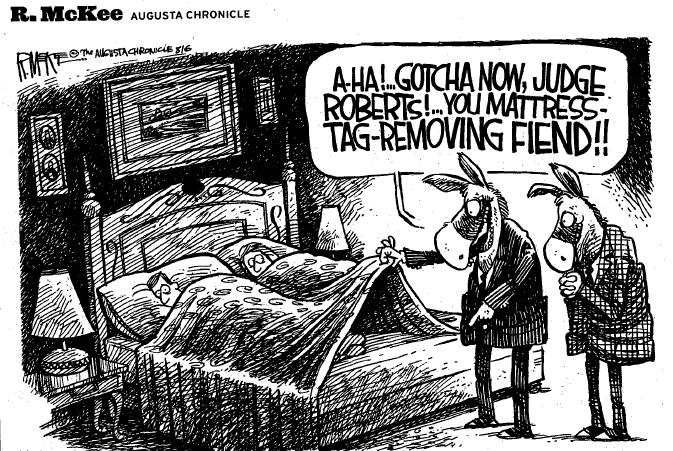
This political cartoon from the San Diego Union Tribune gave me a good chuckle this morning. Democratic partisans are trying very hard to dig up dirt on President Bush’s SCOTUS nominee, but haven’t come up with anything. When Drudge revealed that the NYT was looking into adoption records of Roberts’ children, my eyes became cross, but I didn’t expect anything else from the liberal rag. By the way, PowerPundit has a great roundup of commentary on that scandal.
My eyes became more than cross at Drudge’s latest newsflash: CNN Agrees to Air Bloody Abortion Ad on Judge Roberts.
I heard about it from Captain Ed on the Hugh Hewitt show yesterday and couldn’t believe it. I’m not sure if CNN has decided to back down yet, but the ad itself is pretty repulsive, not to mention blatantly false. Miguel Miranda takes NARAL to task in an Opinion Journal piece this morning.
Here’s the ad:
Announcer: Seven years ago, a bomb destroyed a woman's health clinic in Birmingham, Ala.Factcheck.org is all over this ad, writing “in words and images, the ad conveys the idea that Roberts took a legal position excusing bombing of abortion clinics, which is false.”Emily Lyons: When a bomb ripped through my clinic, I almost lost my life. I will never be the same.
Announcer: Supreme Court nominee John Roberts filed court briefs supporting violent fringe groups and a convicted clinic bomber.
Lyons: I'm determined to stop this violence, so I'm speaking out.
Announcer: Call your senators. Tell them to oppose John Roberts. America can't afford a justice whose ideology leads him to excuse violence against other Americans.
Fact Check links to an image of a letter penned by Roberts which states clearly that those responsible for abortion clinic bombings “should be prosecuted to the full extent of the law” and added, “No matter how lofty or sincerely held the goal, those who resort to violence to achieve it are criminals.”
This is clearly a breach of decency from a radical fringe group on the left. CNN’s commitment to mislead America with this ad is reprehensible, but the silence from Democratic leaders is truly despicable.
Posted by Rick at 04:30 PM | Comments (9) | TrackBack
The Virtuous Nation: Clinton's Best Legacy?
Ah, I know that's going to make a few toupees spin on some heads. Is Thecla actually suggesting that the national trend toward the virtuous, extolled here by David Brooks, is due to the presidency of Bill Clinton?
Well...yeah. Okay...yes and no. But...yeah.
I come to this conclusion by noting that the trends toward virtue that Brooks outlines in his piece all begin in the late 1980's or early 1990's. Teen pregnancies down, abortions down, family violence down, violence in general down.
Bill Clinton might have vetoed the GOP written welfare reform several times before finally, in an election year - signing the legislation. But he signed it. Amid all of the predictions of gloom and doom, the certainty of the left that the world would end should welfare-as-we-then-knew-it be updated and reformed, Clinton signed.
The world did not end. What ended was the seeming-entrenchment of a whole group of people, of all ethnic backgrounds, into a hopeless dependence upon the government which led nowhere, gave no promise, encouraged no future, thwarted dreams and individual potential, and perpetuated the whole idea of dependence, of inability, of needing a caretaker.
I think when folks were liberated from the shackles of socially-engineered government dependence, when they were able to move away from the racist neighborhood of "poor you, you can't manage your life, let us do it for you," into the relatively more progressive town of "there is help to get you there but you can do it" they grew in self-respect, self-confidence and - most importantly - in hope. The message of "you can, if you try" was a louder, clearer and more spiritually sustaining message than "you can't, so give up"
What President Bush has called "the soft racism of low-expectations" was pushed back, and the effect is not surprising. When folks - any folks, of any background -are using their own gifts and ingenuity to make their way, they have reason to hold up their heads, to defer failure and pursue their dreams and goals.
When folks feel good about what they are doing, when they feel like they have some control over the direction their lives take - they have hope. And hope is not simply a feeling. Hope says, "awake, O Sleeper, arise from death!" Hope is the builder of bridges, the tamer of winds, the harnesser of ideas and possibilities. A poor man with hope is immeasurably richer than a wealthy man without it, because he carries within him the spark that can alight a thousand tomorrows.
By the curb, toward the edge of the flagging,
A knife-grinder works at his wheel, sharpening a great knife;
Bending over, he carefully holds it to the stone—by foot and knee,
With measur’d tread, he turns rapidly—As he presses with light but firm hand,
Forth issue, then, in copious golden jets,
Sparkles from the wheel.
- Walt Whitman "Sparkles from the Wheel"
Hope sparkles from the wheel, and all possibility is contained therein. And the man who can sharpen his own knife, and teach his children that craft, will never be helpless or hungry or cast aside. He will, therefore, be at peace, and so will his house.
Clinton signed welfare reform into law. And it has been a good thing, a better thing - perhaps - than many of us even realize. I don't know how loudly he will want to crow this particular legacy, however. After all, it only proves - once again - that socialism is the robber of human spirit, that socialism does not work.
Crossposted at www.theclamauro.com
Posted by Thecla at 03:20 PM | Comments (3) | TrackBack
Faith-based Evolution
Could there be a scientist who has accepted Intelligent Design as being on par with evolution? Dr. Roy W. Spencer says, "I came to the realization that intelligent design, as a theory of origins, is no more religious, and no less scientific, than evolutionism."
You might wonder how scientists who are taught to apply disciplined observation and experimentation and to search for natural explanations for what is observed in nature can come to such a conclusion? For those of you who consider themselves open-minded, I will try to explain.
Read the whole thing to discover how much evolution and the physics of the origin of the universe depend heavily on faith (and about how parts of modern explanations of evolution depend on the lack of hard evidence).
(Via JunkYardBlog.)
Posted by Doug at 12:35 PM | Comments (1) | TrackBack
August 09, 2005
A Superhero for Our Times
A superhero out there to protect the right to kill your baby?
An online animated video sponsored by Planned Parenthood's San Francisco-area branch features a superhero character drowning an abstinence promoter in a trash can and blasting into oblivion several pro-life picketers protesting in front of one of the organization's facilities.The eight-minute "A Superhero for Choice," posted on the Planned Parenthood Golden Gate website, has a bespectacled black woman in San Francisco morphing into a red-suited flying enforcer, bent on making the world safe for the organization's values.
The heroine also puts a giant condom on the Washington Monument, confronts a senator who has "misinformed conservatism", and flys off for an appointment with "Jerry Falwell - that schmuck".
So much for a reasoned discourse. This is pure propaganda. Interestingly, while there is a mention of this video on their website ("Meet PPGG's Superhero for CHOICE"), it doesn't actually have a link, while all other items in the same column have one. I wonder if they've realized (or been made to realize) that this is way beyond the pale.
And they say conservatives hold the monopoly on mean-spiritedness.
Posted by Doug at 02:54 PM | Comments (1) | TrackBack
Steve Vincent
I heard about the murder of American journalist Steve Vincent in Iraq last week, but it didn’t connect that he was the same Vincent who blogged at In The Red Zone.
KLO pays tribute to this committed reporter and blogger who apparently died for telling the truth.
Posted by Rick at 11:57 AM | Comments (0) | TrackBack
NCAA goes PC
Josh Britton has the story and adds:
I won’t waste much more time on this tempest-in-a-teapot, except to point out the clash of two “ideals” of higher education orthodoxy: the need to force a form of “diversity” on everyone, and the requirement that no one, anywhere, ever be offended by anything - unless it involves sacreligious art or referring to 9/11 victims as “little Eichmanns.”
Posted by Rick at 10:34 AM | Comments (4) | TrackBack
Still Savoring Summer
In Georgia it feels like the middle of summer, but the kids went back to school yesterday. Assuming it is still summer in most of the country, as it should be, here’s a new blog called Points of Light by my friend Jim Jordan, who is still savoring summer. He and his wife spend a lot of down time in Wisconsin and his descriptions and photos will help you understand why.

Posted by Jim at 07:06 AM | Comments (0) | TrackBack
Defining Evangelicals
Joe Carter at Evangelical Outpost, who just took the job as managing editor of the World Magazine blog (don’t’ know what that means for EO), is defining evangelical for us.
There was a very interesting 2004 conversation on this topic, conducted by the Ethics and Public Policy Center. Titled Understanding American Evangelicals: A Conversation with Mark Noll and Jay Tolson, it includes comments by the two principals and questions from selected journalists.
Mark Noll is particularly good and fascinating on the history of evangelicalism. He has a level head in fitting the modern church into the sweep of history.
Noll uses a David Bebbington recipe in identifying the following ingredients of evangelicalism:
(1) conversion, "the belief that lives need to be changed"; (2) the Bible, the "belief that all spiritual truth is to be found in its pages"; (3) activism, the dedication of all believers, including laypeople, to lives of service for God, especially as manifest in evangelism (spreading the good news) and mission (taking the gospel to other societies); and (4) crucicentrism, the conviction that Christ’s death on the Cross (Latin crux) provided the means of reconciliation between a holy God and sinful human beings.
Noll said in the dialogue:
Since the mid-eighteenth century evangelicals have played a significant role in the history of Christianity, especially on the North American continent and wherever else the British or American empire has spread.3 For much of the nineteenth century, white evangelical Protestants constituted the largest and most influential body of religious adherents in the United States (as also in Britain and Canada). Today groups descended from those eighteenth- and nineteenth-century movements are more visible than they had been for several decades. A majority of those in full-time preparation for the ministry in the Church of Eng-land have, for some years, been trained in evangelical colleges. In Canada, a majority of the Protestants in church on any given Sunday are in evangelical congregations. And throughout the world, Pentecostal and charismatic movements, which trace their lineage to developments within Anglo-American evangelicalism early in the twentieth century, are far and away the fastest-growing segments of world-wide Christianity.
Posted by Jim at 06:52 AM | Comments (4) | TrackBack
A Peter Jennings Moment
What I remember Peter Jennings for is that he was the driving force behind hiring Peggy Wehmeyer at ABCNEWS in 1994 as the first correspondent to report for a network on religious and spiritual issues. Peggy served in that role for a number of years.
Based in the ABCNEWS' Dallas bureau, she reported for World News Tonight with Peter Jennings, 20/20 and PrimeTime Live. As an evangelical, she was anguished by maintaining her Christian faith while listening to the pleas of fellow evangelicals and the accusations that she was favoring them. Wehmeyer said consistently that Jennings was her biggest ally
Posted by Jim at 06:36 AM | Comments (0) | TrackBack
August 08, 2005
In Focus: Soldiers' Angels
If you've read blogs lately, listened to Hugh Hewitt or...well...done a lot of other things - you've probably heard about Soldiers' Angels.
Maybe you've even adopted a Soldier. If so, way to go!! :) But I know that I used to thing that adopting a soldier and sending him or her packages and letters was the only think I could do with this great organization - besides giving them money that is :)
Of course, adopting a soldier is always an option, and a great one. They give you the soldier's address and sometimes email and so you can communicate in a lot of ways.
But there are many other opportunities...
If you don't want to commit to a single soldier or can't afford the cost of sending packages, you can join the Soldiers' Angels Letter Writing Team. With the LWT, you pick a day on which you wish to receive a name - or two days (mine are Monday and Thursday) and each week on your chosen day(s), they send you the name and address of a soldier, and maybe something about them, and you send a card or letter.
In their words:
"Just once! No long term commitment, unless you find a
friend!!! If you are interested in joining the Letter Writing Team,
please contact Linda at lindom@gmail.com."
This is a great program because even without sending packages, mail call is such an important time for the military, getting a surprise note of support from back home is such an encouragement - and sometimes, they write you back!! :)
Now, if you don't want to send mail and buy stamps, but obviously have email (you're reading this right?) you can join the "E-Squad - Email Support Team"
It's easy. You write to SA, tell them you want to join, they write you back with an email address and you start emailing. No cost and not much time commitment. You can write the emails while you are waiting for the Stones Cry Out page to load...and perhaps, refresh :)
For more information, email Mel at melsfaves2000@hotmail.com.
Here are some other opportunities, as described by Soldiers' Angels themselves:
Adopt Another Soldier
Whether your soldier is still fighting for our freedoms or has already come home, we need angels to volunteer to adopt another soldier! It is heartbreaking to hear stories of soldiers who never get to hear their name called at mail call. We need to make sure that this doesn't happen!!! Countless soldiers have told us the joy they felt when their name was called at mail call, and then to find that someone they
didn't even know had taken it upon themselves to adopt them and provide support to them. Some have cried. If you can adopt a new soldier today, email us at 2ndAdoptions@gmail.com.
Wounded TLC Team
Have a special place in your heart for our heroes who have been wounded in the line of duty? The Wounded TLC Team is exactly what you have been looking for. These brave men and women have sacrificed so much and could use some real encouragement! If you have a heart for these soldiers, please contact Elaine at bakerdzen@earthlink.net.
And still more teams available which you can find out about by visiting the message boards.
~~
For any other Soldiers' Angles questions you can email them directly at SAMembership@gmail.com. They are great about giving whatever information you need. They are there to help you help the Military :)
Really, I can't stress enough how a simple letter can make a difference. Last week I got the name of a soldier in a remote area of Afghanistan, many of the troops serving with him don't get any mail and they are asking for simple things like socks, batteries and letters. So I'll be sending him an envelope full of cards addressed to "any soldier" so that he can hand them out to the people in need. If you have extra stationary and note cards lying around, this is an awesome use of those resources :)
Please consider these opportunities to say Thank you to the soldiers. They will be so thankful to you :)
Posted by Abigail at 10:19 PM | Comments (0) | TrackBack
The Mainline Breaks Toward the Terrorists
The Presbyterian Church USA voted at its convention last week to threaten a handful of corporations that provide military-related equipment to Israel. Listen to this statement. The NY Times reported:
“The Presbyterian committee said in its announcement that it included United Technologies Corporation, a military contractor, because a subsidiary provides helicopters used by the Israeli military “in attacks in the occupied territories against suspected Palestinian terrorists.”And the problem with that is? (As a side note, does any really believe that Mossad doesn’t know who the Palestinian leaders are? They’re not suspected; they’re identified and eliminated).
The divestment threats of the mainline denominations against corporations that provide selected products to Israel underscores the moral bankruptcy of these religious groups. It would be of more concern if these fading bodies had a vibrant, growing presence, but they are shrinking in size and influence.
The Stop Divestment from Israel blog has a good compilation on the efforts by mainline churches to hurt Israel. FrontPageMag.com says these groups may be violating U.S. law
My friend Rabbi Yechiel Eckstein of the International Fellowship of Christians and Jews said of the divestment actions:
“At the same time that we’re seeing the results of 25 years of efforts in bringing together Jewish and evangelical groups in support of Israel, we’re also facing the sobering reality of mainline denominations not only turning their backs on Israel, but lining up to viciously attack the only Middle Eastern country with democratic values and practices.”
Although I have never supported the Christian leaders and groups that blindly approve every action of the modern state of Israel as though it is led by Moses himself, the actions by the UCC, the Presbyterian Church USA and others to undermine the only stable democracy in the Middle East and an ally of the United States are unconscionable.
The liberal gaggle of mainline churches, the National Council of Churches, took another blow last week, when the Antiochian Orthodox Christian Archdiocese of North America withdrew its membership. According to Scripps Howard columnist Terry Mattingly:
“The Antiochian archdiocese quit the council, in large part, because of what he called an "almost a politicized agenda" under [executive director Bob] Edgar -- with a strong emphasis on sexual liberation and opposition to conservative Christianity.”
I am not without sympathy for the Palestinian people, but not for the terrorists who have been killing Israeli citizens for years.
I have been to Israel twice; not as a tourist, but to work with a client called Nazareth Village that runs a First Century Village and an interactive center on the life of Jesus—in his hometown. It is a wonderful multi-denominational Christian group that is a great source of inspiration and reconciliation in the largest Arab town in Israel.
During those visits I met with and came to love a number of Palestinian Christians, many whose families have been Christians for many generations. They have no love for the Israeli government, but neither do they support Palestinian terrorism. They are in a difficult place, and I think of them whenever I read of trouble in northern Israel.
I pray for the peace of Jerusalem. But trying to disable Israel and prevent it from protecting its people is a foolish and naïve way for Christians to work for that peace.
Posted by Jim at 06:31 AM | Comments (1) | TrackBack
August 06, 2005
Great Economic News
The Daily Missive runs down the great economic news of this week. President Bush credits the tax cuts, as he should, but let's not forget the credit due to the hard working American people.
Posted by Rick at 11:37 PM | Comments (0) | TrackBack
The Israeli Terrorist
On Thursday, a deserter from the Israeli army opened fire on a bus in Galilee, and killed 4 Israeli Arabs (including the bus driver). Then the people on the bus and a crowd from the outside (because the bus was stopped) surrounded the gunman and began to beat him with stones. The mob was over 200 strong and the gunman was killed.
There are many issues here, the first being how this is covered in the press, since it was an Israeli gunman fighting for Israeli rights. Here are some quotes from the Boston Globe:
The attack was one of the deadliest by an Israeli on Palestinian civilians in years, and it followed predictions by security services that some opponents of the Gaza withdrawal would take extreme measures to prevent it as the Aug. 17 starting date approaches. In particular, Israeli authorities have said, opponents might launch attacks on Palestinians to draw reprisals against Israelis and reignite fighting between the two sides -- perhaps forcing the government to reconsider the plan.
I don't know, but I don't think that Palestinians need an excuse to blow up Israelis. Let me be clear that I think this man was wrong to open fire on this bus and I have no sympathy for him. But the Globe seems to be showing more sympathy for Palestinians as victims in this one paragraph than the press as a whole has ever shown to Israeli victims.
However, they are kind enough to include this quote:
Many settlers and their supporters plan to resist soldiers and police officers sent to remove residents. But leaders of the main settlement movement have vowed not to resort to violence."Such incidents cannot be part of the democratic struggle in Israel," a settler leader, Bentsi Lieberman, said to reporters near the Gaza Strip, where thousands have protested in recent days.
It's clear that Israelis understand they can't resort to violence in their protests - terrorist style violence anyway. I would like to see some recognition of the fact that Israelis themselves are stepping up to say that what this Israeli gunman did was wrong. Why is this so hard for Arabs to understand?
Here is Prime Minister Sharon's statement, condemning the attack. It's good to know that Sharon condemns all terrorist attacks, even the Israeli ones. As James Taranto said yesterday:
In the typical terrorist attack by Palestinian Arabs, Palestinian officials, if they criticize it at all, do so only on the ground that it's counterproductive, and the parents usually hail their child's "martyrdom." So, while Jewish terrorists are every bit as despicable as Arab ones, Israel's response to this atrocity shows that Jewish civilization is vastly superior to its Arab counterpart.
I agree. Jewish civilization is superior to Arab civilization. It's more respectable to not honor terrorists or superficially condemn them just because they share your race. However, what sort of "civility" do we see in Israel if a crazy mob comes and kills someone like that? I understand that the Israeli people live in constant threat of a bus bomber, that they have for years and that they've pretty much had it with terrorists in their country. They started fighting this war against terror years before September 11. But does all of this necessitate the crazy mob mentality?
I mean, even if, right after 9/11, a similar thing had happened on a New York bus, right near Ground Zero, would we see this kind of mob? Would we see Americans beating a gunman to death, rather than restraining him, dipping their hands in his blood rather than calling the police?
It's a whole different culture in the Middle East. I heard someone say on the news the other day (Oh, maybe it was Rich Lowry) that Muslims in India don't have the same culture of hate for Jews and other non-Muslims, that there is something particular to the Arab world that makes the interpretation of the Koran more deadly.
It's different in the Middle East. More different than I think we've been willing to admit in our desire for peace and unity. The Israeli government may indeed be more civil and responsible than its Arab counterpart when it comes to condemning terror in all forms. However, what passes as civil and humane among the citizens themselves is far different from what we would imagine here in America.
Of course we wouldn't dance in the streets over another country's tragedy either.
Posted by Abigail at 12:21 PM | Comments (0) | TrackBack
Evangelicals Within Denomination Endure Actions of UCC Synod
My reporting on the United Church of Christ convention in Atlanta is online now at ChristianityToday.com.
Although evangelicals remaining in the United Church of Christ have grown accustomed to scenes at the national synod like the cross-dressed Transgender Gospel Choir singing Amazing Grace, decisions at the July meeting in Atlanta were disturbing to the theologically conservative remnant in the most liberal Christian denomination in America.
The UCC Synod passed resolutions endorsing gay marriage and supporting divestment of funds involving Israel.
Jesus is Lord Resolution Seen as Bright Spot
At the same time, the Synod passed a resolution affirming the person and work of Jesus Christ as Lord and Savior, while refusing to add the affirmation to ordination vows.
Rev. David Runnion-Bareford, director of the Biblical Witness Fellowship, a voice for evangelical renewal in the UCC, is disappointed in the gay marriage and divestment decisions but not surprised by actions of the Synod, which he says is out of touch with UCC churches.
“We draw encouragement from resurgence in hundreds of UCC-affiliated local churches where the Gospel is being preached for the first time in years,” Runnion-Bareford said. “In an internal survey, 27 percent of people who attend UCC churches identify themselves as evangelical. And two-thirds of the local churches in the UCC send no funds to the national group.”
Rev. Brent Becker of St. Paul United Church of Christ in Cibolo, Texas, who wrote an unsuccessful counter-resolution affirming marriage as the union of a man and woman, said: “The leadership hailed the July 4 resolution endorsing gay marriage as some kind of independence for the denomination. I believe it signaled the Synod’s independence from the clear teaching of Jesus in Matthew 19: 4-6, and the counsel of the rest of Scripture. It established UCC independence from every other Christian group, and from the beliefs and scholarship of 2000 years of church history.”
Posted by Jim at 10:54 AM | Comments (0) | TrackBack
August 05, 2005
Rev. Fred Phelps on the March
Anyone know about so-called Rev. Fred Phelps’ and his Westboro Baptist Church in Topeka Kansas? The group picketed the Holy Cross Catholic Church in the military community of Dover with the message: Military deaths in Iraq are God’s vengeance for tolerance of gays in the United States.
Now it appears they have taken to the private funerals of military personnel killed in action. Phelps’ group stood across the street from Grace Evangelical Church shouting and waving signs during the funeral of 21-year-old Army Spc. Edward Myers.
"The first sin was being a part of this military. If this young man had a clue and any fear of God, he would have run, and not walked, from this military," said protester Shirley Phelps-Roper. "Who would serve a nation that is godless and has flipped off, defiantly defied, defiantly flipped off, the Lord their God?"Satan is a clever little devil isn’t he? All he has to do is put on the cloth, attach a title, and proclaim perversion of God’s word and many will point to him as a follower of Christ. If we as Christians are doing our job, that is modeling Christ in our daily lives, the differences between Phelps’s followers and Spirit filled believers would be the difference between night and day.One protester had an American flag tied to his belt that draped to the ground. He was holding a sign that read, "Thank God For IEDs," which are explosive devices used by insurgents to blow up military convoys.
Posted by Rick at 11:45 PM | Comments (8) | TrackBack
Rich Review: Lowry at YAF
This afternoon, for whatever reason, I stopped the DVD I was watching and flipped the channels...delighted to discover National Review's Rich Lowry on CSPAN speaking at the Young America's Foundation Conservative Student Conference.
While I missed his actual speech, I saw much of the question and answer, and it was so good - I took notes! So if you weren't blessed enough to be at the conference and you weren't one of the other 6 CSPAN viewers, here are some high points you missed: (And they aren't in chronological order, in case you are checking up on me:)
1. "Real" Journalism
A student asked about the fact that many who work for National Review had other jobs before becoming journalists and what advice Lowry had for those that wanted to be journalists later in life. After humorously confessing to being a journalism geek (while in high school he video-taped Fireline and played it back until he was sure he had all the arguments correct) he came down on the "elite/mainstream" media for saying that you have to go to journalism school in order to be a "real" journalist. He said that journalism school is often a waste of time and that people hoping to write should read as much as they can and write as much as they can and that
journalism is basically calling people on the phone and getting them to tell you things and then summarizing it.
Ha! I wonder if Mr. Rather would stoop to that kind of description :)
2. The Rise of China
Lowry - It's dangerous when a rising power cannot discern its true national interest
He said that this phenomenon occurred in Germany, pre-World War I when it alienated the rest of Europe for no apparent reason. He expressed concern that China would make a similar mistake.
He may be onto something, because really...has China seemed to exhibit any kind of clear strategy? They maintain this crazy big brother communist grip on their country by monitoring phone calls, letters and emails - but at the same time exalt business growth and other capitalist principles.
However, perhaps it would be worse if China did have some sort of master plan to take over the world - assuming of course that it was better than what Pinky and the Brain would try to implement on a weekly basis.
3. It's just too crazy in North Korea
In the course of answering a question about what to do about the "Axis of Evil" Lowry said:
How much pressure can you put on a guy who's happy to have his people starve and eat grass?
Yeah...good point. I mean, it's already horrible for people in that country and obviously Kim Jong Il doesn't care too much about his country, except for the areas that contain nukes. However, Lowry adds:
China can put pressure on them, but they won't...Perhaps we should say to China "You seem happy with proliferation in the region, so maybe Japan needs nukes too."
This is another good point about China. If they think Kim is too crazy to use the nukes he loves, they might not care how many he makes or tests or whatever. But if they knew that nearby countries with non-crazy leaders had nuclear capabilities they may feel differently about the whole things, especially if those countries decided to side with Taiwan.
4. The Ubiquitous Border Question
I've been meaning to write about this for some time as the Ranger and I have had some discussions about it - and today Rich made my point in just a few sentences:
It's hard to shut down the border as a border because it's just too large. You could stengthen it in certain points but then of course you have the problem of immigrants going to other areas. The key is internal enforcement
YES! Exactly. He went on to describe how we have to crack down on employers who hire illegal immigrants and refuse to give them driver's licenses. He said we have to basically say "If you broke our laws to come into this country, we don't want you here. Go home."
That sounds right and he admits it will be "very painful" but it's a lot easier and more cost efficient (not to mention feasible) than covering every foot of the border. People are contributing to law breaking inside the country and we already have agencies set up to handle this, let's handle it. If immigrants know that we are cracking down, I don't think they will be as eager to come.
Most important, Lowry added, is that these steps need to be taken before any temporary guest worker program can be put in place.
5. Intelligence Reform?
Will it happen? Can it happen? Lowry contends that the most recent changes are simply like "moving boxes" and not real reform. Unfortunately, he doesn't hold out hope for real reform. He sites some intelligence failures about what it was like on the ground in Iraq - how the electricity was barely working and that if we had a CIA agent simply walk down the street they would have known that.
Mostly though he says that what we need are people who are willing to go into the tough places, blend into the landscape - learning the language and the culture. That real reform means that:
We need people willing to deal with tough, nasty people and ready to do tough, nasty things without, if something goes wrong, being called in front of a congressional committee.
This is so absolutely true. There is very little that can substitute for on the ground human intelligence and if our military and CIA have to worry about reports and questions when working in places like Iraq, Iran, Syria, North Korea and China - they won't be able to do the work that needs to be done.
~~
That's the round up. It was quite good, so if you are flipping the channels and happen upon Rich Lowry on CSPAN, stop a minute and see what there is to learn :)
Posted by Abigail at 11:23 PM | Comments (0) | TrackBack
Something Stinks in Louisiana
We spent the day yesterday at the Louisiana State Penitentiary at Angola, where 5,108 men with life sentences (at least 66 years) are spending the remainder of their days. It’s a farm, really, 116,000 acres surrounded on three sides by the Mississippi Rivers, scattered with low building filled with men and surrounded by razor wire and towers with armed guards.
Life in prison has a character all its own when prisoners know their last days will be there. While time in a southern work camp is rarely easy, the experience of prisoners at Angola is really what they make of it. If they have years of good conduct, they see a lot more of the acreage and they experience remarkable freedom within the confines of the farm. Screw up and they'll spend 23 hours a day looking at the walls of 6 X 9 cell.
There’s much to say about Angola and much has, indeed, been written about this unique place. We were there to discuss the plans of the children’s ministry called Awana to connect children with their incarcerated fathers in a remarkable event on September 10 , and to get them memorizing Scripture together, even though they will spend almost all of their days apart.
But I came away with a grinding, insipid sickness about the most obvious reality of Angola, which has nothing to do with the way the fine warden and his staff run the place: 80% of the men at Angola are African-American. Yes, 80% of the men sentenced to life in the state of Louisiana are black.
I spent the day in prison seeing results, not studying causes. But as I drove the two plus hours back to New Orleans, there was the recurring thought that something here is screwed up in a big way. Something stinks, and it's coming from Louisiana.
It may be that the black culture is producing thugs. It may be that poverty is a great predictor of criminal behavior and poverty besets the black publication far more in Louisiana. It may be that the criminal justice system in the state is far more likely to arrest and convict a black man than a white man, and far more likely to sentence a black man to life in prison than a white man. And it may be all of these things.
Angola is a remarkable place with a lot of bad people and a lot of rather good ones. You can sense that God is at work in there, where the sins are grievous and well-known, where there is little hope aside from the hope God provides, and where redemption is strikingly obvious.
But something needs to be done to address the problem of this state throwing so many black bodies into a farm of bondage with too many cement walls.
Posted by Jim at 06:43 PM | Comments (0) | TrackBack
The Religous Test
Via Dean Esmay comes a link to Manual Miranda's column "Judging While Catholic". Miranda seeks to educate journalists on what the "religious test" prohibition in the Constitution really means.
In Wednesday's Washington Post ("Why It's Right to Ask About Roberts's Faith"), columnist E.J. Dionne asks: "Is it wrong to question Judge John Roberts on how his Catholic faith might affect his decisions as a Supreme Court justice? Or is it wrong not to? . . . Why is it wrong to ask him to share his reflections with the public?" It would be helpful, Mr. Dionne concludes, "if Roberts gave an account of how (and whether) his religious convictions would affect his decisions as a justice."Mr. Dionne's error is found is his own words: "Yes, any inquiry related to a nominee's religion risks being seen as a form of bigotry, and of course there should be no 'religious tests.' " Indeed. And that is the problem, again.
Journalists believe that the religious test clause guards against simple discrimination against Catholics or Jews or any other particular denominations. It does not. It prohibits a probe of what the potential officeholder believes derived of his religious convictions. It is not about what he lists on a questionnaire under religion, as if it were like race or sex. That is why the liberal press has mocked the concern raised by conservatives that the abortion litmus test and other lines of inquiry are a constitutionally prohibited religious test.
(Read the whole thing for more examples and further historical evidence of Miranda's reading of the "religious test".)
One of the commenters at Dean's World seems to have this same misconception. So consider this: Suppose this "religious test" was really a "duck test", such that you could not require a test to see if the potential office holder was a duck. And then imagine a Senator being interviewed after the vote saying, "I voted against this nominee because he looks like a duck, walks like a duck, quacks like a duck and thinks like a duck. Now, I didn't vote against him because he is a duck, but because he had those qualities."
That wouldn't pass either the "duck test" nor the "smell test". And questions about John Roberts' religious views won't pass the "religious test".
Posted by Doug at 01:57 PM | Comments (0) | TrackBack
August 04, 2005
Ethical Sources of Embryonic Stem Cells
Clayton Cramer has come up with an idea for a source of hundreds of thousands of embryonic stem cells every year, without the ethical issues.
There are several sources of embryonic stem cells, however, that provide no ethical problems: non-elective abortions; miscarriages; and deaths of pregnant women. Ectopic pregnancies are one example of a non-elective abortion, and even the Catholic Church recognizes that this is legitimate. Since there are about 100,000 ectopic pregnancies a year, this is a vast number of sources of embryonic stem cells.Miscarriages also produce embryonic tissue--and since a miscarriage is not an intentional act of killing the embryo, there is no ethical problem is using this tissue for research. I couldn't find a figure for the number of miscarriages annually, but I would be surprised if it isn't in the hundreds of thousands.
At any given time, there are hundreds of thousands of American women who are pregnant. Unsurprisingly, there are on any day hundreds of pregnant women who are killed in car accidents, murders, falls from ladders, or other circumstances where the embryo or fetus can't be saved. These are also legitimate sources of embryonic stem cells.
(Comments below the fold...)
The third item is a little morbid, but no less a viable source. As much as I've come out against embryonic stem cell research as "human experimentation", I have to admit that these ideas do have merit. As opposed to IVF embryos or abortions, there is no actual choice involved; nature has already taken its course. I consider all these cases a loss of life, but not one where any blame or culpability can typically be assigned. We do have a big source of embryonic stem cells. Is the scientific community willing to work with it?
Clayton does end his post with a reasonable caution.
I can see why some might be concerned about where embryonic stem cell research might take us. For example, imagine that the scientists doing this research find a way to fulfill all the promises that Al Gore and John Edwards made last year: a cure of paralysis; for cancer; for Alzheimer's--in short, the miracle cure. Would this lead to an increase in demand for embryonic stem cells? It certainly would, and I could see a serious debate about whether to use aborted embryos and fetuses in making this miracle cure. I would come down against this--but that isn't the question before us right now. We do have an ethical source for embryonic stem cells for research purposes.
Posted by Doug at 04:29 PM | Comments (6) | TrackBack
Where to Hold the ID Debate
Snippets from blogs on Bush's "Intelligent Design should be taught in school" remark. Spot the repeating thread.
Protein Wisdom - "Similarly, I have no problem with Intelligent Design being taught alongside evolution in the context of questions concerning the origin of life-which, whether the President meant to do so or not, is in fact the context into which he placed the question. The origin of life-or first cause-is properly asked within the realm of philosophy or religious studies."
Ballon Juice - "I have no problem with a brief fifteen minute discussion of intelligent design as part of a religious/philosophy class, provided schools offer those courses."
DrivelBlog - In short, let science classes be science classes, and leave theoretical arguments for other classes such as philosophy."
Two Babes and a Brain - "How is this science? How by proving order and adherence to "rules" does this indicate an Intelligent" Design? ... Here is the thing: this theory is taught in philosophy or religion class--not science."
MovieBob - "Matters of faith, spirituality and the supernatural are philosophy, and Intelligent Design belongs in a philosophy class."
Louisiana Libertarian - "Intelligent design is not a serious scientific theory. It is the belief that some "intelligent designer" (ie. God or some space aliens) designed DNA to evolve in a programmed manner. That's not science, that's philosophy. It should be discussed in a religion or philosophy class, not taught as an alternative to evolution."
All these are wonderful suggestions as a potential place to put ID. But of course they're disingenuous because...well, let's let another blogger snippet say it:
L's Simple Observations - "It is a sad day when we are teaching philosophy in our Science classrooms. Maybe we should create an elective in High Schools that simply covers religion and philosophy...oh wait...there's no religion in public schools, but there can be Intelligent Design????"
So thus we have a whole host of people giving a reasonable-sounding suggestion yet which has an absolute zero chance of happening. Religion class? Forget it. Philosophy class? Perhaps as a low-attendance elective.
Any other suggestions? I mean, ones that have a snowball's chance in Havana of actually happening.
My main point here (and I'll admit, it's a little opaque) is that if you don't think ID has any place in school, just say so. That's a debate worth having. But if we're just going to get suggestions that could never happen in today's educational climate, that's not really a debate.
A fair result could be obtained only by fully stating and balancing the facts on both sides of each question. Oh, that idea isn't original with me. It's a quote from Charles Darwin in the Introduction to "The Origin of Species".
A good blog for keeping up with the ID side of the debate is Intelligent Design The Future.
Posted by Doug at 12:23 PM | Comments (8) | TrackBack
Sacrifice
The Washington Post does America a great service by allowing us to get to know 8 of the Marines who died earlier this week and their families. I encourage you to read every name, every story, and pray for these grieving families. My heart weighs heavy for these families and their sacrifice.
Posted by Rick at 11:33 AM | Comments (0) | TrackBack
Christians In Danger on the Horn of Africa
Christians in Eritrea are being arrested and detained without trial for no apparent reason other than the government’s desire to limit surging growth of the evangelical church. Eritrea’s constitution calls for freedom of religion, and there is religious plurality, with the nation split largely between Sunni Muslim and the Eritrean Orthodox church, with lesser numbers of Catholics and evangelicals.
But Christianity Today reports that recent growth by the evangelical church is of concern to the Marxist-tinged government, which has begun to brutalize, intimidate, and imprison these believers.
The U.S. State Department has designated Eritrea as a Country of Particular Concern for severe violations of religious freedom. But this designation requires that further action be taken by our government if Eritrea failed to improve its record (by March 2005). CT says that nothing has been done by the U.S., despite continuing persecution of Christians.
Speak up for the Christians of tiny Eritrea. Urge the Bush Administration to take action against the oppressive North African government if its does not release these prisoners of conscience and stop harassment of followers of Christ.
There’s more information at Compass Direct .
Posted by Jim at 09:16 AM | Comments (0) | TrackBack
August 03, 2005
It's more than just science
Usually I agree with Charles Krauthammer, but tonight on Special Report w/Brit Hume, he said some things that gave me pause. The discussion among the All-stars for the second segment was about the teaching of Evolution/Intelligent Design. Now while it's true that I may disagree with Krauthammer's position about this, but that's not what I want to discuss here.
First Krauthammer said that "Evolution is the foundation" of all areas of science
"take it away and you have nothing left."
While I could grant that evolution has stimulated a lot of biological discoveries and research, we could still talk about all those results without demanding that evolution is true. Without evolution, we could still talk about mitosis. We could still study the genus and species (not to mention the phylum) of all sorts of animals and insects. Science education and scientific research wouldn't stop without evolution. The same way astronomy didn't end when we realized the cosmos didn't revolve around the earth
So, if it ever happens that we consider not teaching evolution, don't worry about the rest of science disappearing. It will all still be there.
Second, after Bill Sammon said that Red Staters would come to the polls if there was an initiative to teach intelligent design in schools, Krauthammer said "Science is not determined at the polling place."
He's right, Science is not determined at the polling place, but educational guidelines about school science classes are determined at the polling places in the sense that they are determined by state wide school boards, which are responsible to the electorate in some way.
If the Ohio school board wanted to require science teachers to teach Scientology as scientific fact, they have to know that Ohio parents would stage some kind of revolt. Whether that is protests or moving kids to private schools, or most extreme, moving kids to another state - there would be repercussions. The knowledge of that fact is what keeps school guidelines from being as liberal as they would probably like them to be.
Posted by Abigail at 08:45 PM | Comments (4) | TrackBack
The Brewing Scandal Over Air America That the Media is Ignoring
One scandal that has been brewing throughout the blogosphere has been the story that the CEO of Air America, the liberal talk radio network, "borrowed" money from a New York charity that he served in order to help alleviate the network's financial problems.
As Ed Morissey points out in his column for the Daily Standard, this is a story that is ripe for media coverage. However, because of the political affiliation of the personalities involved, the mainstream media has remained largely silent.
Granted, the mainstream media's willingness to provide cover for political allies (i.e. liberals) is nothing new. But you can be certain that if this story involved conservatives the media would be jumping all over it.
Michelle Malkin takes a look at the story from another angle. Also check out Scott Ott's latest entry at Scrappleface.
Posted by Tom at 03:37 PM | Comments (3) | TrackBack
More Christians in China than Communists?
China's rulers are said to be ambiguous about Christianity's growth. Some see its emphasis on personal morality as a force for stability. House churches which go along with the authority and theology of the official organisations are often left alone.But many reject the party's control over Christian practice and doctrine, and these are seen as a threat. After all, 80 million members would mean there are now more Christians than Communists in China.
Few believe that many of the party's 70 million members keep the faith burning any more.
This year the Politburo made it easier for churches to register, but at the same time launched a wave of persecution of those which refused.
But will this make Christians the new "Falun Gong"?
Posted by Doug at 01:33 PM | Comments (4) | TrackBack
France Shakes Hands with Common Sense
Has anyone else noticed the spate of recent stories suggesting a French government trend toward common sense?
First we learn that France expelled a Muslim preacher of hate to combat terrorism and plans to expel more, including French citizens. Earlier this week, France urged the UN to intervene with Iran for its decision to resume nuclear activities. Now comes word that the government, plagued by >10% unemployment, eased up labor laws making it easier for smaller firms to hire and terminate employees.
Posted by Rick at 11:14 AM | Comments (0) | TrackBack
Heirs of the Sixties
While Jesus said that the peacemakers are blessed, today’s supposed peace movement is no place for the followers of Christ. For those who criticize America’s involvement in Iraq—not strategic or tactical decisions, but the right and need for action—are not seeking to make peace but to make nice. And to alter evil by taking its hand.
While pacifism is a legitimate theological template, although difficult for me to understand in the face of the vile evil of our age, I do not believe Christians can defend identification with and verbal support of the enemies of freedom and faith. How can we understand the Left’s utter fascination with and sympathy for Islamic terrorists and the ideology of oppression that is at its core?
It is reminiscent of the Religious Left’s alignment with the Marxists of earlier decades. The self-described “penitent former liberal” who writes thoughtfully at the Blue Goldfish blog said:
“The evil spirit demanding a response of that age in the early 1970s was that of the Marxist tyranny known as communism. And from the Christian Left, there was - indeed - enabling, useful foolishness, appeasement, apologies, and complete denial.”
And this quote from Richard John Neuhaus:
At the height of Mao’s cultural revolution in which as many as thirty million died, the National Council of Churches published a booklet hailing China as an admirably “Christian” society. In 1981, 60 Minutes did an hour-long program on the National Council of Churches’ support for Marxist causes, and I spoke with Morley Safer about religious leaders who had become “apologists for oppression.” That was the end of some important friendships, or at least I thought they were friends. I was then a much younger man, learning slowly and painfully what many had learned before. Allegiance to the left, however variously defined, was a religion, and dissent was punished by excommunication.
Today, the liberals desire to oppose the Republican administration has morphed into the absurdity of defending and excusing the utter evil of Saddam and al Queda and developing an apologetic for addressing the oppression of poor Middle Eastern Muslims as the way to stop the ideology of terror that is producing the bomb throwers of our time.
The anti-war activists of today’s Religious Left are the heirs of yesterday’s NCC Marxist sympathizers. They have no footing in the church of Jesus Christ.
Posted by Jim at 07:54 AM | Comments (4) | TrackBack
August 02, 2005
Nanotechnology
I first heard of nanotechnology as a freshman at UCSD in 1994. I was assured that a revolution was underway. Now comes word of a possible victory in the fight against cancer that could be won with without traditional medicine.
Researcher Dr Hongjie Dai said: "One of the longstanding problems in medicine is how to cure cancer without harming normal body tissue.They may have found this holy grail of cancer research in nanotechnology."Standard chemotherapy destroys cancer cells and normal cells alike.
"That's why patients often lose their hair and suffer numerous other side effects."For us, the Holy Grail would be finding a way to selectively kill cancer cells and not damage healthy ones."
Posted by Rick at 02:25 PM | Comments (0) | TrackBack
The Sounds of Repositioning
As Congress slips out of the August Washington swamp and John Bolton slips into the United Nations, that other sound you hear this summer is that of potential presidential candidates re-positioning themselves for an election that is still three years away.
Hillary Clinton has been doing the sidestroke to the right all year, and last week it appeared that Bill Frist was paddling slightly to the left. I’m not certain the Senate Majority Leader was doing anything but staking out a position on stem cell research that should not be surprising, given his urging of President Bush to consider federal funding of the research in the past.
But the criticism of Frist from conservatives has been bitter and despondent, as if they’d been betrayed by a friend.
Frist’s position, though, is not all that radical, and it is close to that of Massachusetts Governor Mitt Romney. Although opposing the creation of embryos for the purposes of research, embryos that would be destroyed by fertility clinics could instead be used for research.
I agree with Romney and Frist on that proposal. It would not result in the creation of human life for the purpose of destroying it—even for laudatory research. But rather than embryos being destroyed with no further benefit, they could be used to advance science and the quality of life.
There’s more on Romney’s repositioning in a NY Times article today.
On many social issues, Mr. Romney has recently appeared to stake out ground to the right of many constituents but slightly to the left of the country's most conservative Republicans.Instead of taking the pure conservative position of opposing all embryonic stem cell research, Mr. Romney, whose state is full of leading scientists, has said he supports using embryos if they are leftovers from fertility clinics, but not if they were created solely for research.
Mr. Romney wants to reinstate capital punishment in Massachusetts, but his proposal for a "foolproof" death penalty restricts when it can be applied to the point that some conservatives say it would make executions exceedingly rare.
Even on gay marriage, which Mr. Romney has consistently opposed, his record is not universally praised by conservatives. They applaud that he invoked a 1913 law to prohibit same-sex couples residing outside Massachusetts from getting married in the state. But Mr. Romney's support of a constitutional amendment last year to ban gay marriage but also create civil unions upset some conservatives.
Posted by Jim at 08:26 AM | Comments (3) | TrackBack
August 01, 2005
China: Isolation or Engagement?
I'm a bit of a talk-show geek (from way back). When I do call, I'm often able to record it and use it as part of a blog post. This morning I called "Bill Bennett's Morning in America", where one of the topics was engaging or isolating China.
When I last talked to Bill Bennett on this topic, I said that there were people on both sides of the China debate that I respected, and I had a tough time deciding which way I thought we should go. This morning, Bill talked to Arthur Waldron, VP of the International Assessment & Strategy Center who said, among other things, that the human rights situation in China is as bad as it's ever been. It appears that our policy of engagement there hasn't reaped many benefits, so I said that this is making me lean the other direction; a direction Mr. Bennett is leaning as well.
However, I'm including in this clip the first bit from the next caller, who does make a good point that things may be shifting in China. My question would be, "but are they moving as fast as they could be?"
Click here to listen. [This recording from Bill Bennett's Morning in America (WGKA, Atlanta, GA on 8/1/2005 8:37am EST (733K).]
Posted by Doug at 10:24 AM | Comments (5) | TrackBack
Embryonic Stem Cell Research: A Done Deal?
Thomas over at Redstate.org has a very impassioned post about why embryonic stem cell research is wrong. He's equally certain that we're going to lose this issue, at least in the short term. An excerpt:
Our Priesthood has declared that embryonic stem cell research is vital. When The Scientific Community tells us that we need something to put off death, we embrace it wholeheartedly. Scientists are no different from other human beings: They want to do Big Things, they want their work to Make a Difference, and they are, as are we all, selfish, flawed creatures. I'm not quite sure when or why we decided to elevate them to the level of a secular priesthood, but we did so, and they are now solemnly assuring us that they need to be able to take people apart for spare parts. Like a good group of Faithful, we will bow to our betters and give them what they demand, for they will reward us with the divine gift of an extra month in the actuarial tables for our fidelity and obedience.It is precisely that simple. The folks to whom we've delegated far too much of our moral decision-making -- and thank God we held those reins fifty years ago -- are telling us that what the conscience should know is depraved is licit, and more than that, is necessary. They want to play with their toys without moral supervision. They're offering us one heck of a potential payoff. You'd better believe we're going to snap it up.
Read the whole thing. He's not suggesting giving up, but he's letting folks know how he sees the debate going.
Posted by Doug at 09:35 AM | Comments (0) | TrackBack
Road Trip
The ribbons of Interstate highway from central Florida to upstate New York have been our home for much of the last two weeks, on a road trip that included family time at theme parks and amusement parks, picnic lunches, a lot of natural beauty, and too much fast food. Here are a few observations from traveling:
--Upstate New York, particularly the Finger Lakes region, is among the most beautiful and interesting that I’ve seen in the country. The region around Ithaca, with it soaring hills, gorges, water falls and the town descending to Cayuga Lake, is dramatic and gorgeous (or “gorges” as the local t-shirts say). The drive on Highway 14 from Watkins Glen to Geneva along Seneca Lake, with vineyards on rolling hills down to the long, seemingly endless lake, felt like a trip along the Mediterranean.
--The first drop on the Superman roller coaster at Six Flags Darien Lake is the biggest and fastest I’ve even been on. What a great thrill ride, even without the loops and corkscrews common to the other thrillers.
--We paid from $2.099 in Atlanta to $2.499 once in New York for gasoline, but the high prices did not keep people off the roads. The Interstates were packed much of the time; the roads were full yesterday through Virginia on I-81 and through the Carolinas, with frustrating delays.
--I believe it was Charles Kuralt who said that because of the Interstate Highway System you could now drive from coast to coast in America and see absolutely nothing. The same is generally true from Florida to the Canadian border. Certainly if a visitor to America was to take the drive we did this week, it would seem obvious that the nation is forested, agrarian, and underpopulated. It does make me wonder why most of us crowd into cities, when there is so much open land and beautiful vistas, even along the east coast.
--How did we as families take long trips without DVD players in the back seats, not to mention Gameboys and CD players with headphones. The license plate and alphabet games only went so far.
--Returning from long, fast travel on crowded roads, I realize how vulnerable we have been every mile and on every turn, and I'm so grateful to God for a safe trip, free from mishap, illness, or breakdown.
The drive was worthwhile to see family and to create new memories for the kids, and for us, but it certainly is good to be home, even if I’d rather be looking out over the Finger Lakes rather than suburban Atlanta.
Now, to figure out what happened in the world while we were gone.
Posted by Jim at 07:40 AM | Comments (0) | TrackBack